

Greenfoot Team
Laura Lee
Faulkner.
Director of Marketing
Laura Lee brings over 15 years of HVAC industry experience to Greenfoot. She spent 15 years as Marketing Director at Kerr Controls Ltd, Atlantic Canada's leading HVAC distributor, where she worked closely with contractors across Nova Scotia, New Brunswick, Newfoundland and Labrador, Prince Edward Island, and Ontario. As Greenfoot's Director of Marketing, she translates that deep B2B knowledge into clear, helpful guidance for homeowners.
Author
Laura

What Has Laura Written About?
Browse the latest articles and guides published by Laura Lee Faulkner on energy efficiency, heat pumps, and home comfort.
Mini-Split vs. Ducted Heat Pump: Which Is Better for Canadian Homes in 2026?
A ductless mini-split is usually the better retrofit choice for a Canadian home without existing ductwork, while a ducted central heat pump makes more sense when good ductwork is already in place. Laura Lee Faulkner covers the four deciding factors, real 2026 cost ranges from $3,000 to $35,000+, cold-climate performance at -25C, the retrofit challenge in older homes, energy savings comparisons, and current rebate programs across Atlantic Canada and BC.
Read article →Best Insulation for Older British Columbia Homes in 2026
British Columbia spans climate zones 4 through 8, so there is no single best insulation for older BC homes. Coastal homes must prioritize rain control and outward drying before wall fill. Interior and northern homes need higher R-values and wind-tight assemblies. Blown-in cellulose is a strong attic option everywhere; spray foam is best used selectively at rim joists; exterior mineral wool is the best deep-wall upgrade during recladding. Better Homes BC 2026 programs include the Home Renovation Rebate Program (up to $5,500 for insulation), the income-based Energy Savings Program (updated July 6, 2026), and the free Energy Conservation Assistance Program. Contractor registration and pre-approval are required for all three.
Read article →Best Insulation for Older Prince Edward Island Homes in 2026
For older PEI homes, the best insulation sequence is control bulk water first, then air seal, then bring a properly vented attic to R-50 to R-60 with blown-in cellulose. Rim joists and basement walls are next when dry. Dense-pack cellulose can improve empty wall cavities; continuous exterior mineral wool is the better answer during recladding. The 2026 efficiencyPEI programs include a Free Home Insulation Program for households below $55,000 income, formula-based standard rebates starting with a $99 audit, and the Energy Efficiency Loan Program providing up to $10,000 at 5% over 7 years. All programs require approval before work begins.
Read article →Best Insulation for Older Newfoundland and Labrador Homes in 2026
For older Newfoundland and Labrador homes, the right insulation depends on coastal vs. inland conditions. Attic blown-in cellulose targets R-50 to R-55 on the island and R-60 in Labrador. TakeCharge rebates cover up to $3,000 for combined attic and basement work. The NLHC Home Energy Savings Program stopped new applications June 15, 2026 pending fall 2026 program changes that will raise forgivable-loan amounts to $10,000 (NL) and $13,000 (Labrador). Closed-cell spray foam is best at rim joists and difficult coastal details. Continuous exterior mineral wool is the best whole-wall upgrade during recladding.
Read article →Best Insulation for Older New Brunswick Homes in 2026
For older New Brunswick homes, the best insulation strategy starts with a full assessment, attic sealing and R-60 blown-in cellulose, and targeted closed-cell spray foam at rim joists and crawl spaces. Dense-pack cellulose works for accessible wall cavities; continuous exterior mineral wool is the better answer for thermal bridging during recladding. SaveEnergyNB's Total Home program covers attics to R-60, walls to R-30, basements to R-30, and headers to R-40. Households below $70,000 income can access no-cost upgrades through the Enhanced Energy Savings Program. The correct program must be registered before work begins.
Read article →Best Insulation for Older Nova Scotia Homes in 2026
The best insulation for an older Nova Scotia home depends on wall assembly and moisture risk. Attic blown-in cellulose to R-60 is the highest-return first upgrade. Spray foam excels at rim joists and crawl spaces in balloon-framed homes; dense-pack cellulose suits historic plaster walls via drill-and-fill; exterior mineral wool addresses thermal bridging without interior disruption. Air sealing and an HRV are prerequisites to any tightening work. 2026 Efficiency NS rebates reach up to $5,000 standard, $15,000 for moderate-income households, and $30,000 when stacked with the Oil to Heat Pump Affordability Program.
Read article →How Much Does It Cost to Switch From Oil Heat to a Heat Pump?
Heating with oil is expensive in Atlantic Canada. Here is what it really costs to switch from oil heat to a heat pump, including equipment, installation, rebates, running-cost comparisons, and real payback examples for oil-heated homes.
Read article →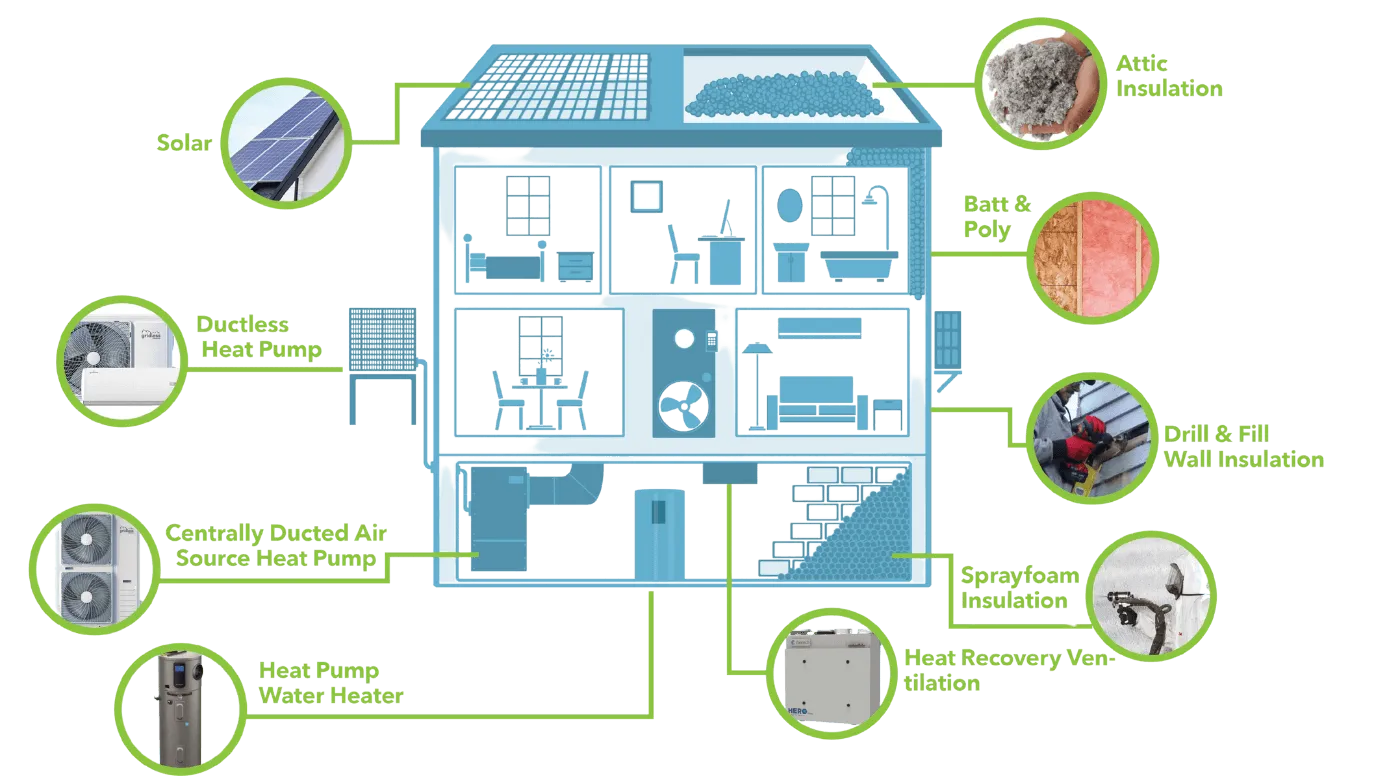
Invest In Your Home
Our experts have spent decades helping homeowners across Atlantic Canada and BC make smarter, longer-lasting investments in comfort and efficiency. From heat pumps and solar to insulation and air quality, we help you choose what's right for your home and your budget.
That is the Greenfoot approach!