Insulation is one of those home upgrades people know they should deal with eventually.
Then they picture the attic, the basement, the contractor and the bill.
So they put it off.
That might be a mistake.
Across New Brunswick, Nova Scotia, Prince Edward Island, Newfoundland and Labrador, and British Columbia, insulation programs range from partial rebates to fully funded, approved upgrades for qualifying households.
For some homeowners, new insulation technically is free.
For others, rebates cover enough of the project to make an upgrade far less expensive than expected.
The first step is figuring out which program applies to you before the work starts.
Find Insulation Programs in Your Province
Start with our insulation rebate overview, or use the page for your province:
- New Brunswick insulation rebates
- Nova Scotia insulation rebates
- Prince Edward Island insulation rebates
- Newfoundland and Labrador insulation rebates
- British Columbia insulation rebates
These pages explain the options and let you request a Greenfoot consultation. They do not register you with a government or utility program. Always confirm the current rules with the program administrator.
Why Insulation Is Worth Looking at Before Your Next Heating Upgrade
Your heating system replaces the heat your home keeps losing.
Insulation slows that loss.
Natural Resources Canada estimates walls can account for about 20% of heat loss in a house.
Basements deserve even more attention. NRCan says basements can account for roughly 25% of total home heat loss, especially when foundation walls, headers and air leakage have never been properly addressed.
Those are general heat-loss estimates, not the percentage you are guaranteed to save on your bill.
An under-insulated house asks your furnace, baseboards or heat pump to replace that lost heat all winter.
Then summer arrives and the same weak building envelope makes keeping the house cool harder.
Adding insulation attacks the problem before your heating or cooling equipment has to solve it.
So, Can Insulation Really Be Free?
Yes, if you qualify for approved work through one of the income-qualified programs available in several provinces Greenfoot serves.
New Brunswick, Nova Scotia, Prince Edward Island and British Columbia have programs where qualifying households can receive insulation or other approved energy upgrades at no cost.
Newfoundland and Labrador takes a different approach. Its standard TakeCharge insulation rebate supports eligible attic and basement insulation in homes that meet its electric-heating requirements, with a total maximum of up to $3,000.
Homeowners who do not qualify for no-cost programs may still have access to standard insulation rebates.
Whether insulation is free depends on your province, income, home and the work the program approves. The headline is not a blanket offer of free Greenfoot installation.
New Brunswick: Insulation Can Be Fully Funded
New Brunswick has two very different routes depending on household income.
Enhanced Energy Savings Program
If your combined gross household income is under $70,000 per year, you may qualify for the Enhanced Energy Savings Program.
The program is open to qualifying homeowners regardless of how the house is heated.
Approved homes can receive energy-efficiency upgrades at no cost, with insulation and air sealing among the improvements considered.
You must:
- Own and live in the home
- Have household income under the program limit
- Have a home that needs eligible efficiency improvements
An energy assessment determines what upgrades are appropriate. Income eligibility alone does not guarantee approval or a particular project.
For an approved household with an under-insulated home, covered insulation work can genuinely cost the homeowner $0. Apply through the program and wait for its instructions before arranging work.
Total Home Energy Savings Program
If you do not qualify for the no-cost program, SaveEnergyNB's Total Home Energy Savings Program offers insulation rebates based on the amount of insulation added and the area upgraded.
Published examples include:
- Attic insulation: up to $0.85 per square foot, depending on the qualifying insulation level
- Exterior walls: up to $2.25 per square foot
- Basement and crawlspace walls: up to $2.00 per square foot
- Basement headers: up to $3.00 per square foot
- Exposed floors: up to $3.00 per square foot
- Basement slab insulation: up to $2.20 per square foot
These are maximum rates, not flat payments for every project. Minimum R-values, eligible area and program requirements apply. At least 20% of the applicable building component normally needs to be upgraded.
New Brunswick also offers separate air-sealing incentives based on the measured reduction in air leakage. Check the current program rules for the amount and assessment requirements.
Explore New Brunswick insulation options with Greenfoot.
Nova Scotia: Some Homeowners Pay Nothing
Nova Scotia has one of the clearest no-cost programs.
HomeWarming
Efficiency Nova Scotia's HomeWarming program provides qualifying lower-income homeowners with a free Home Energy Assessment.
If the assessment finds that insulation, draft-proofing or other improvements would meaningfully reduce energy use, the program reviews the recommendations. If approved, Efficiency Nova Scotia arranges the work and covers the installation cost.
No loan. No insulation bill for the work the program approves and provides.
The published after-tax household income limits are:
- 1 person: $30,187
- 2 to 4 people: $57,075
- 5 or more people: $79,163
The program calculates this using line 23600 minus line 43500 on Notices of Assessment for household members age 18 and older. Limits are reviewed periodically; check the current rules when you apply.
The program decides which upgrades suit each house. Qualifying does not guarantee every possible insulation project will be completed or that you can select your own contractor.
Moderate Income and Home Energy Assessment Rebates
Households above the HomeWarming limits still have options.
Nova Scotia's Moderate Income Rebate program supports eligible households with upgrades including better insulation.
Qualifying homeowners may receive up to $5,000 through the Moderate Income Rebate and combine that with up to $5,000 through the Home Energy Assessment program, where stacking is permitted.
That is up to $10,000 across qualifying home-energy upgrades, not a $10,000 insulation-only payment. Measure limits, approval dates and the home's assessment determine the final amount.
Explore Nova Scotia insulation options with Greenfoot.
Prince Edward Island: There Is Literally a Free Insulation Program
PEI makes the headline of this article easy to defend.
The province operates a program called Free Home Insulation.
For approved work under this program, there are no upfront insulation costs, loan payments, contractor bills or material bills for the participating homeowner.
The program is aimed at low- to moderate-income homeowners. Published eligibility includes:
- Total household income under $55,000
- You own the home
- The home is your primary residence
- The home's tax-assessed value is $300,000 or less
If you qualify and the work is approved, the province provides the contractor and materials. Apply through efficiencyPEI; do not assume a separately booked Greenfoot project will be covered.
What If You Do Not Qualify for Free Insulation?
PEI also offers standard Home Insulation Rebates for homeowners and landlords.
Eligible work includes insulation, air sealing, and qualifying ENERGY STAR windows and doors. The province offers higher rebate levels to eligible lower-income applicants.
A home energy assessment is required before work starts and is currently offered at a subsidized rate of $99 plus HST.
Wait for approval before starting. PEI warns that work completed before program approval will not be reimbursed.
Explore PEI insulation options with Greenfoot.
Newfoundland and Labrador: Get Up to $3,000 Back
Newfoundland and Labrador does not use the same fully funded model for its standard insulation rebate.
TakeCharge advertises 75% of eligible attic and basement insulation costs, subject to separate material and labour caps:
- Up to $1,000 toward attic insulation materials
- Up to $500 toward attic insulation labour
- Up to $1,000 toward basement insulation materials
- Up to $500 toward basement insulation labour
Maximum total rebate: up to $3,000. It is not 75% of every item on a renovation invoice. The rebate applies to eligible pre-tax insulation and labour costs; other materials, such as studding and vapour barrier, are excluded.
Your home's primary heat source must be electric. If an additional heating source is used, the home must meet TakeCharge's minimum annual electricity-use requirement of 15,000 kWh. Other home and project eligibility conditions also apply.
Minimum and maximum R-values depend on location and the area being insulated. Check TakeCharge's current project table, including Labrador requirements, before buying materials.
CSA-approved batt, rigid board, blown-in and spray foam insulation with a verifiable R-value can qualify. Spray foam must be installed by a participating professional installer.
Keep eligible receipts. Other rebates may affect the amount TakeCharge pays, and combining programs does not automatically allow reimbursement above eligible costs.
What Could the Energy Savings Look Like?
TakeCharge gives illustrative savings of more than $700 per year for basement insulation and up to about $250 per year for attic top-ups. These are the provider's examples, not guaranteed results or amounts to add to your rebate.
Actual savings depend on your home, existing insulation, heating system, energy prices and use.
Explore Newfoundland and Labrador insulation options with Greenfoot.
British Columbia: No-Cost Programs and Up to $5,500 in Insulation Rebates
B.C. has different routes depending on household income and program eligibility.
Energy Conservation Assistance Program
For eligible income-qualified households, the Energy Conservation Assistance Program offers free assessments, coaching and approved energy-efficiency upgrades.
Insulation is one of the upgrades listed. A program representative evaluates the home, determines which upgrades qualify and arranges the approved work.
Approved upgrades are free to the participating household. The program controls eligibility and delivery; it is not a promise that an independently arranged insulation job will be free.
Home Renovation Rebate Program
Homeowners who do not qualify for no-cost work may still access insulation incentives.
The Home Renovation Rebate Program, funded by BC Hydro and FortisBC with the Province of B.C., lists insulation rebates of up to $5,500 per home.
Eligible categories can include attics, exterior walls, basement and crawlspace walls, exposed floors, and basement headers. Individual measures have their own caps and insulation requirements.
The $5,500 is a maximum across eligible insulation work, not an automatic payment for one attic or every homeowner. Utility-account, property, contractor and installation requirements apply.
Explore B.C. insulation options with Greenfoot.
Why “Close to Free” Is Sometimes More Important Than “Free”
Free programs get the attention. Standard rebates deserve attention too.
Consider a homeowner who needs an attic top-up anyway. The better question is:
What does the upgrade cost after an approved rebate, and how much energy might the improved insulation stop you from buying afterward?
There is no universal “close to free” price. Your written quote, eligible costs, approved funding, taxes and work outside the program determine what you pay.
Once installed, insulation has no motor to run or fuel to buy. It keeps slowing heat transfer year after year. Savings still vary from house to house.
Which Parts of the House Should You Insulate First?
Do not assume the attic automatically comes first.
Attics are often cost-effective to improve, but the largest problem in your home might be somewhere else. A proper assessment looks at the whole building envelope.
Common problem areas include:
- Attics with thin or uneven insulation
- Uninsulated basement walls
- Rim joists and basement headers
- Crawlspaces
- Exterior walls in older homes
- Floors over unheated garages or crawlspaces
- Gaps around plumbing, wiring and penetrations
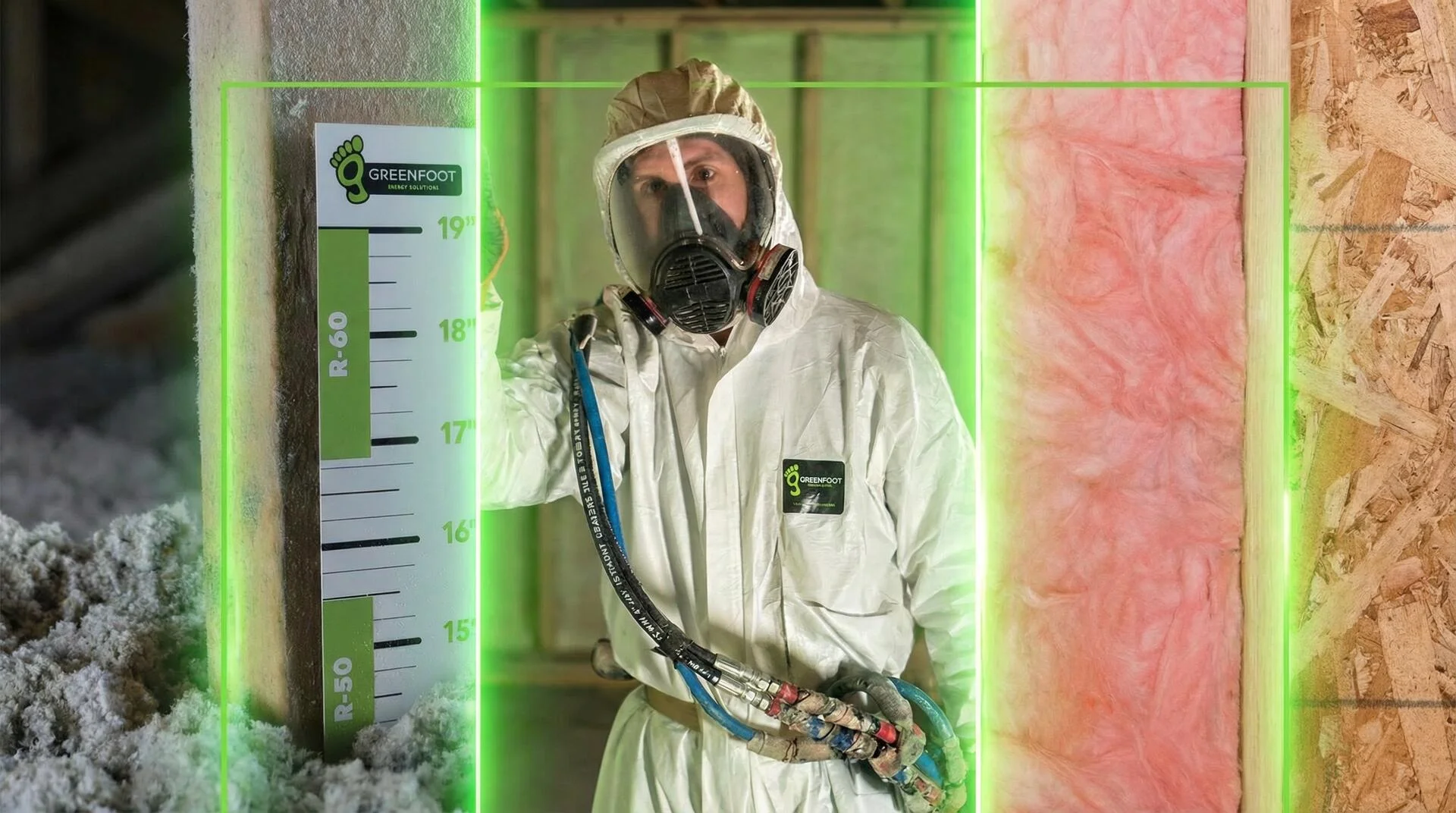
Greenfoot offers insulation services across Atlantic Canada and British Columbia, including blown-in, batt and spray foam solutions.
Insulation and Air Sealing Work Better Together
Insulation slows heat moving through materials. Air sealing deals with warm air escaping through gaps and cracks. You often need both.
An attic might have plenty of insulation but still lose heat around plumbing stacks, wiring penetrations and attic hatches.
NRCan stresses air sealing when upgrading attic insulation.
Several provincial programs recognize the relationship. New Brunswick offers air-sealing incentives, HomeWarming includes draft-proofing, and PEI includes airtightness improvements in its rebate program.
An assessment should look for leaks rather than only measuring insulation depth. Moisture control, ventilation and safe installation also matter.
Do Not Start the Work Before Checking the Rebate
Some programs require pre-registration, income approval, a home energy assessment, an approved contractor, minimum R-values, photographs or final inspections.
If you insulate first and apply later, the project might no longer qualify. PEI explicitly requires approval before work begins. Other programs have their own sequence and deadlines.
Check first. Install second. Greenfoot can walk you through the available information and application steps, but the program administrator decides eligibility and funding. We do not guarantee approval or file your application on your behalf.
How Much Insulation Does Your Home Need?
There is no single R-value for every Canadian home. Climate and the part of the house being insulated both matter.
Natural Resources Canada's Keeping the Heat In guide explains how the building envelope works.
A home in coastal British Columbia has a different heating climate from a home in Labrador. Insulation should suit the house and location, not a one-size-fits-all number.
What Type of Insulation Qualifies?
Program rules vary. Common materials include blown-in insulation, fibreglass or mineral wool batts, rigid board and spray foam. Product certification, application, R-value and installer requirements still apply.
Blown-in insulation works well for many attic top-ups. Spray foam combines insulation and air sealing in suitable applications. Batt and rigid products suit other wall, basement and renovation situations.
Greenfoot installs multiple insulation types rather than forcing every home into the same solution. Not every product or application qualifies under every program.
Insulation Rebate FAQs
Can I get free insulation in Canada?
Some income-qualified programs in New Brunswick, Nova Scotia, Prince Edward Island and British Columbia cover approved insulation or efficiency work at no cost. Eligibility, assessment and program approval are required. This is not a general offer of free Greenfoot installation.
Is insulation free in New Brunswick?
New Brunswick homeowners with combined annual gross household income under $70,000 may qualify for the Enhanced Energy Savings Program. An assessment and program approval determine which upgrades are provided at no cost.
Is insulation free in Nova Scotia?
HomeWarming arranges approved insulation and draft-proofing at no cost for qualifying lower-income homeowners. After-tax household income, home eligibility, assessment and program approval apply.
Does PEI still offer free insulation?
PEI's Free Home Insulation program is for qualifying owner-occupants with household income under $55,000 and a home tax-assessed at $300,000 or less. The program must approve the work and provides the contractor and materials.
How much is the Newfoundland insulation rebate?
TakeCharge lists up to $3,000 across eligible attic and basement insulation, with separate material and labour caps. The home must meet electric-heating requirements. Eligible costs, R-values, receipts and other conditions determine the actual rebate.
How much is the B.C. insulation rebate?
The Home Renovation Rebate Program lists up to $5,500 per home for qualifying insulation, with individual measure limits. Separately, income-qualified households may receive approved no-cost work through the Energy Conservation Assistance Program.
Do I need an energy audit for an insulation rebate?
It depends on the program. Several require an assessment or approval before work starts. Confirm the sequence, contractor rules and deadlines directly with the program administrator before committing to work.
Does attic insulation lower heating bills?
Improving insufficient insulation can reduce heat loss and heating demand. Savings are not guaranteed and depend on the starting insulation, air leakage, climate, heating system, energy prices and how the home is used.
Is insulation worth doing before installing a heat pump?
Often, yes. Reducing heat loss can lower heating demand and may affect the size of heat pump the home needs. A home assessment helps identify appropriate insulation, air sealing and heating upgrades.
You Might Be Paying to Heat the Outdoors
If your attic, basement or walls are under-insulated, buying a more efficient heating system only solves part of the problem. The house still loses heat.
Insulation deals with the building first. Provincial programs may help pay for approved work, and some qualifying households can receive covered upgrades at no cost.
Greenfoot provides insulation services throughout New Brunswick, Nova Scotia, Prince Edward Island, Newfoundland and Labrador, and British Columbia.
You can also read our 2026 guide to insulation rebates in Atlantic Canada and B.C..
Explore your province's insulation options and request a Greenfoot consultation. A consultation is separate from applying for a no-cost program.