
The best insulation for an older Prince Edward Island home depends on much more than the R-value printed on the bag. Island homes face cold winters, strong coastal winds, salt air, wind-driven rain, freeze-thaw cycles, and foundation moisture influenced by local grading and soil conditions. A material that looks ideal on paper can fail if it is installed over a wet foundation, against rain-damaged sheathing, or inside a wall that no longer has a safe drying path.
Many older PEI homes were built with shallow 2x4 walls, board sheathing, plaster-and-lath finishes, minimal attic air sealing, and stone, block, or early concrete foundations. Later bungalows may have fibreglass batts, but gaps, compression, and thermal bridging can reduce real performance well below the nominal R-value.
The best retrofit is usually a sequence rather than a product: control bulk water, measure air leakage, seal the attic and foundation transitions, upgrade attic insulation, deal with the rim joist and basement, and approach wall insulation only after the wall assembly is understood.
Why older PEI homes need a different insulation strategy
Historic homes in Charlottetown, Summerside, and rural communities may contain balloon framing, wood sheathing, layered siding, narrow cavities, and plaster interiors that owners want to preserve. Farmhouses and rural homes may also include additions built in different decades, each with a different foundation and air-barrier condition.
Older Prince Edward Island homes cannot be treated as uniform modern assemblies. The contractor needs to identify where the air barrier is, or whether one exists, before adding insulation.
Heritage framing and mixed additions
Balloon framing can create vertical air channels between the basement and attic. Platform-framed additions may interrupt those channels but introduce difficult junctions where old and new walls meet. Knee walls, porch conversions, bay windows, additions over crawl spaces, and low-slope roofs often contain the worst insulation and air leakage in the house.
Dense-pack wall insulation may reduce airflow within empty cavities, but open floor transitions and service chases still need fire blocking and air sealing. The project should map the framing before drilling holes into historic siding or plaster.
PEI's island-wide moisture exposure
Prince Edward Island has a cold maritime climate. Even inland communities remain close to the coast, and wind pressure can drive rain through small defects in siding and flashing. Basements may also experience seasonal dampness from grading, drainage, groundwater, or foundation cracks.
The province's building and development guidance explains the current code framework, while Natural Resources Canada's Keeping the Heat In guide provides the building-science foundation for existing homes.
What is the best insulation for an old house in PEI?
The right material depends on the location and the home's ability to stay dry.
Closed-cell spray foam: useful at rim joists and difficult transitions
Closed-cell spray foam is effective where air leakage and irregular framing make conventional membranes difficult to install. Rim joists, basement headers, cantilevers, porch floors, and crawl-space transitions are common applications.
It should not be sprayed over wet wood, active foundation leaks, or sheathing damaged by rain. Because it can restrict drying, the assembly must be designed so moisture can escape in another direction. Natural Resources Canada's insulation materials guide explains the difference between insulation, air barriers, and vapour-control layers.
Blown-in cellulose: the practical attic choice
Blown-in cellulose is often the most practical attic choice for older PEI homes. It can be added over dry existing insulation and fills around irregular framing to a uniform depth after attic bypasses are sealed. Dense-pack cellulose can also be used in accessible wall cavities, but the existing layers, moisture levels, and drying direction must be confirmed first.
If the home has historic plaster interiors, exterior drilling is usually preferable to preserve the original finish. Cellulose is not an air barrier; the attic hatch, plumbing stacks, partition-wall tops, and chimney chases should all be sealed before insulation is added. Natural Resources Canada explains the importance of air and moisture correction before attic insulation in its roof and attic guide.
Exterior rigid board or mineral wool: the reliable deep-wall option
Continuous exterior insulation is the most effective way to reduce thermal bridging through 2x4 studs. It keeps the existing sheathing warmer and can preserve interior plaster during a deep retrofit. When a deep retrofit is planned, continuous exterior insulation is usually the most reliable way to raise whole-wall performance without sacrificing historic plaster. This approach is most cost-effective when siding is already being replaced.
Where to insulate first and target R-values for PEI
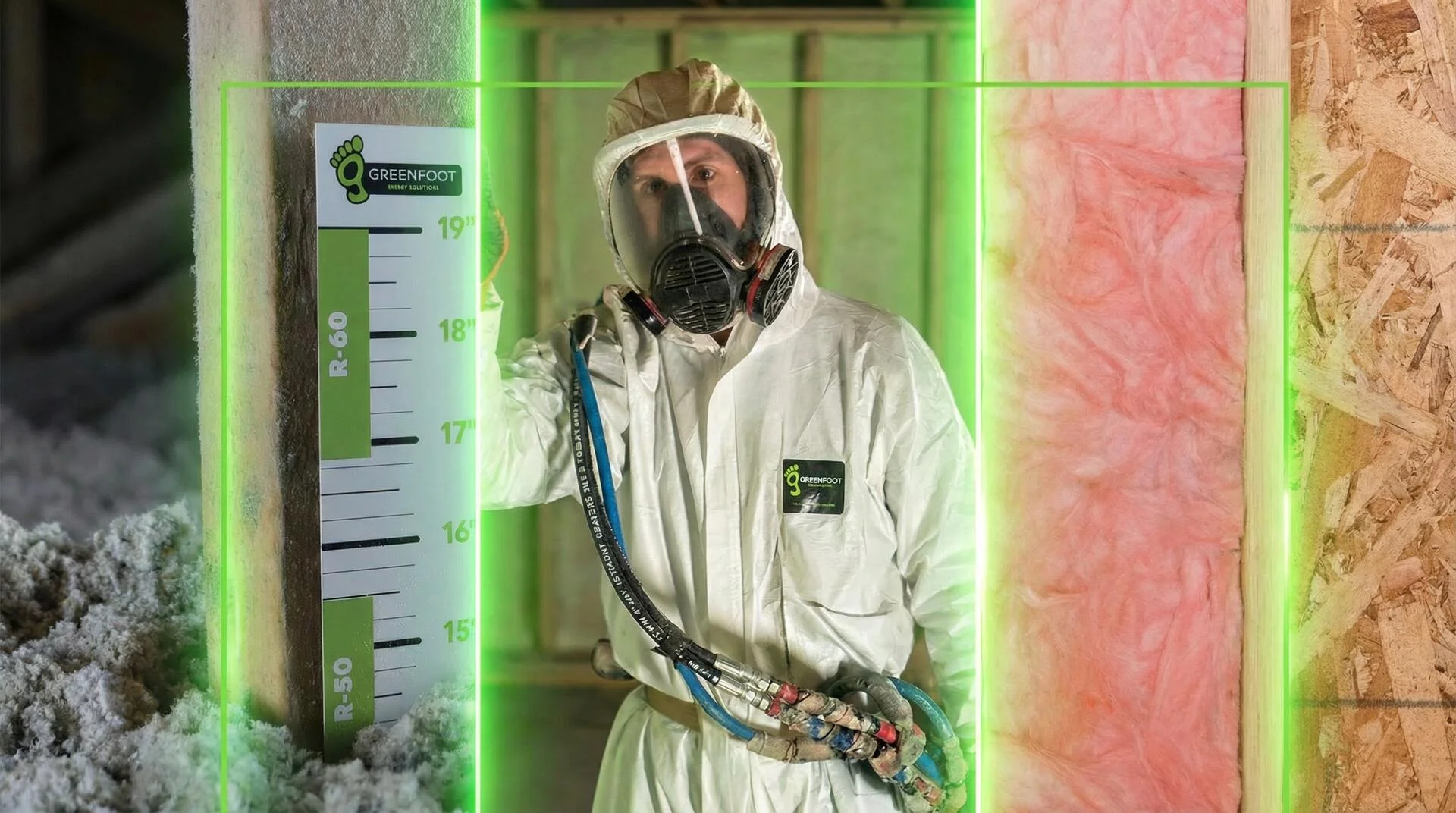
The exact target should be set by an energy audit and the selected efficiencyPEI program. As practical retrofit goals, many older PEI homes benefit from attics in the R-50 to R-60 range, whole walls in the mid-R-20s or better, and dry basement walls around R-20 or higher. Those are planning targets, not a substitute for the rebate formula or permit requirements.
Attic insulation: the highest-return starting point
Attic work is accessible and usually causes less disruption than opening finished walls. The correct sequence is inspection, moisture correction, air sealing, ventilation detailing, and then insulation.
Do not assume more insulation will cure ice dams. Ice dams usually indicate heat escaping into the roof assembly, insufficient air sealing, ventilation defects, or snow and roof geometry issues. The preferred solution is to keep indoor heat and moisture out of the attic.
Basement walls, crawl spaces, and the rim joist
The basement header and sill are common leakage sites. Closed-cell spray foam or carefully sealed rigid board can connect the foundation insulation to the above-grade air barrier, but the foundation must be dry first.
For a dry basement that will be conditioned, wall insulation usually creates a warmer, more useful space than insulating only the floor above. For a low or wet crawl space, the correct approach may be ground-moisture control, drainage, wall insulation, dehumidification, or floor insulation, depending on whether the space will be inside or outside the thermal envelope. Natural Resources Canada's basement insulation guide specifically warns against interior finishing over unresolved moisture.
Wall insulation: preserve drying potential
Dense-pack cellulose can improve an empty cavity, but the contractor should determine whether the wall has tar paper, building paper, board sheathing, foil, polyethylene, impermeable paint, or foam added during an earlier renovation. The combination of layers determines whether the wall can dry. When a deep retrofit is planned, continuous exterior insulation is usually the most reliable way to raise whole-wall performance and reduce cold interior surfaces without sacrificing historic plaster.
Moisture control and ventilation: essential after tightening
Island homes are exposed to outdoor moisture, but the occupants also generate substantial indoor humidity through cooking, bathing, laundry, and normal breathing. That moisture becomes dangerous when warm air leaks into cold walls or attics.
Air sealing before insulation
Natural Resources Canada describes air leakage control as the most important retrofit activity. In older PEI homes, the priority areas are usually the attic plane, rim joist, foundation penetrations, porch and addition connections, attic hatch, and service chases. An energy audit with blower-door testing can identify leakage pathways and help quantify the improvement after the work.
HRV or ERV after a deep retrofit
Once the house is significantly tighter, a balanced HRV or ERV may be needed to control humidity and indoor pollutants. An HRV usually suits a heating-dominated climate because it recovers heat from outgoing air. An ERV can transfer some moisture as well, which may help in certain summer or occupancy conditions. Natural Resources Canada explains certified equipment in its HRV and ERV guide.
PEI ended general HRV equipment rebates on April 15, 2026, so homeowners should not rely on older promotional pages. Current funding should be confirmed through the province's funding and rebates page.
PEI home insulation programs in 2026
On July 7, 2026, the province published a consolidated Home Insulation Programs page covering the free program, standard rebates, required energy audits, and financing.
Free Home Insulation Program
The current free program is for qualifying low- to medium-income homeowners. The published requirements include:
- Total household income under $55,000.
- The applicant owns and occupies the home as a primary residence.
- The property is not seasonal.
- The tax-assessed value is $300,000 or less.
Approved participants receive a custom plan, contractor work, and materials without upfront cost or a loan. The province states that work completed before approval will not be refunded, so applicants should wait for authorization.
Home Insulation Rebates
The standard program is available to eligible homeowners and landlords. It requires an energy audit before work begins and a final inspection after the upgrades. The province currently subsidizes the initial audit so the homeowner pays $99 plus HST. The auditor provides an EnerGuide report, the homeowner completes the work, and the auditor submits the receipts and required documentation to efficiencyPEI. Rebate amounts depend on household income and the type, area, and R-value of the upgrade. Households earning under $35,000 qualify for higher rebate rates.
Because PEI's rebate is formula-based, use the official program calculator and audit report rather than estimating the payment from project cost alone.
Energy Efficiency Loan Program
Approved homeowners under the insulation rebate program may apply for the Energy Efficiency Loan Program before work starts. The current program provides financing of up to $10,000 for eligible pre-approved work, at a fixed five-percent annual interest rate, repayable over as long as seven years. The application must be made before construction begins. Completed projects are not eligible for retroactive financing.
Getting an honest assessment before you start
A complete assessment is more valuable than a quote based only on square footage. Older homes can contain hidden moisture, vermiculite, unsafe wiring, pest contamination, disconnected fan ducts, and incompatible renovation layers.
What a qualified assessment should evaluate
The assessment should review:
- Attic insulation depth and condition.
- Roof leaks, staining, frost, and blocked ventilation.
- Air leakage through the attic plane and foundation.
- Basement or crawl-space water entry and ground moisture.
- Wall sheathing, siding, and likely drying direction.
- Combustion appliances and ventilation requirements.
- Electrical and fire-clearance concerns.
- Which efficiencyPEI program applies before work begins.
Suspect vermiculite should not be disturbed. Health Canada advises homeowners to have potentially asbestos-containing materials assessed before renovation; see Vermiculite insulation containing tremolite asbestos.
Why local PEI experience matters
PEI's climate is geographically compact but still varies by wind exposure, foundation drainage, home age, and renovation history. A Charlottetown heritage house, a rural farmhouse, and a postwar Summerside bungalow need different wall and moisture strategies. Local experience also matters because efficiencyPEI requires approval, audits, documentation, and specific program steps.
The bottom line: get approved, air seal, and start with the attic
For most older PEI homes, the strongest first insulation project is a properly air-sealed attic brought toward R-50 to R-60 after moisture and ventilation issues are corrected. The rim joist and basement walls are next when the foundation is dry.
Dense-pack cellulose can improve suitable wall cavities, but continuous exterior insulation is the better answer for thermal bridging during a siding project. Closed-cell spray foam should be used selectively at difficult air-sealing and foundation transitions rather than sprayed indiscriminately into every old wall.
Most importantly, apply to efficiencyPEI and complete the required audit before work begins. The free program, standard rebate, and loan program all depend on following the correct sequence.
For a house-specific recommendation, book an insulation assessment with Greenfoot Energy Solutions and have the attic, walls, basement, air leakage, and available PEI funding reviewed together.
Explore Greenfoot insulation services and book your free home assessment.