
A ductless mini-split is usually the better retrofit choice for a Canadian home without existing ductwork, especially in older homes, open layouts, additions, and homes that benefit from room-by-room zoning. A ducted central heat pump is usually the better fit when the home already has properly sized, sealed ductwork and the goal is even, whole-home heating and cooling through existing registers. Neither format is automatically more efficient in every house.
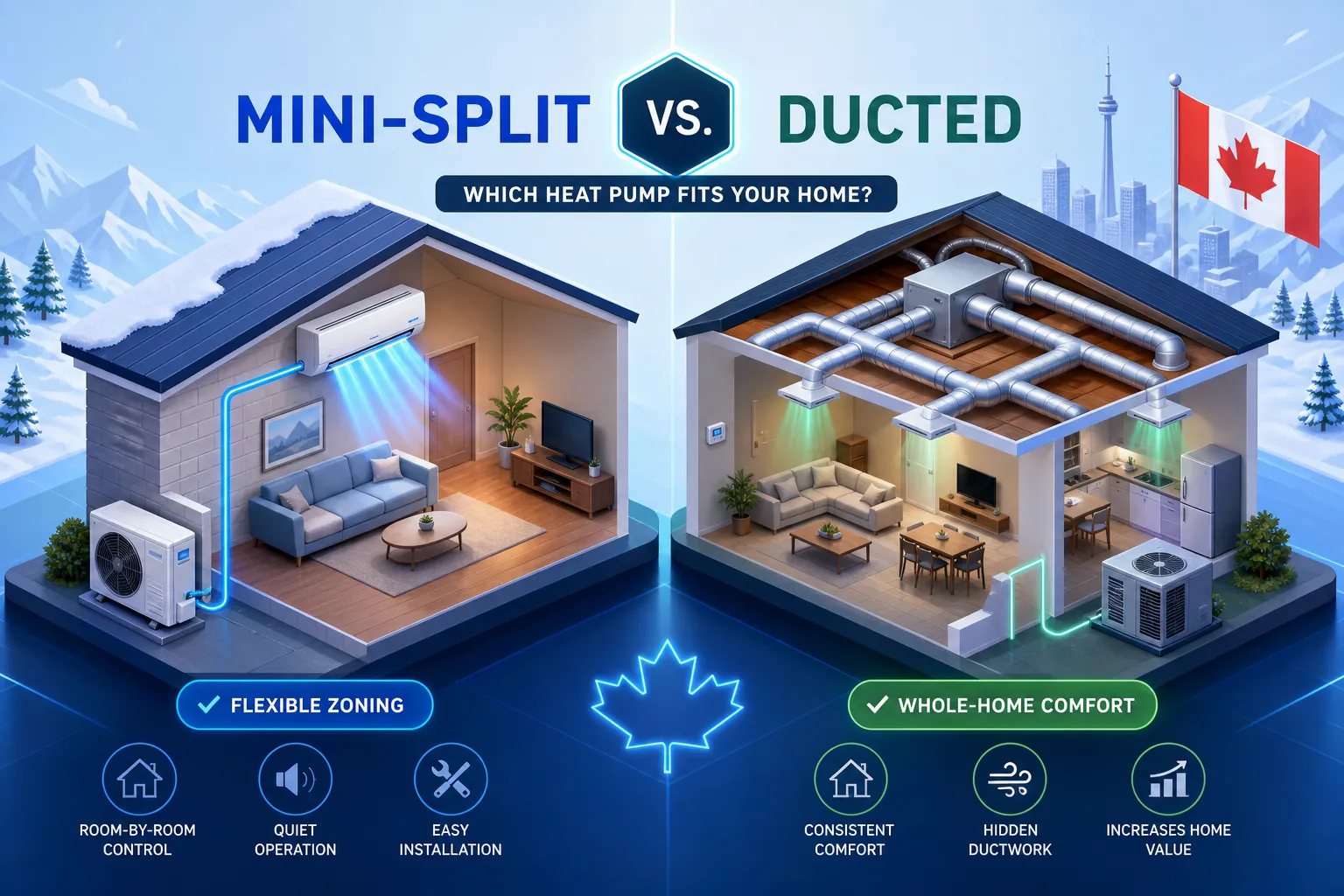
The right question is which one fits your specific home. The answer depends on four things: whether you already have ductwork, how your home is laid out, how cold your winters get, and what you're willing to spend on installation. Get those four factors right and the decision becomes obvious. Get them wrong and you'll pay more than you should for a system that doesn't perform the way you hoped.
The team at Greenfoot Energy Solutions has installed heat pumps across Nova Scotia, New Brunswick, PEI, Newfoundland and Labrador, and BC, working through every combination of home type, heating history, and budget. By the end of this article, you'll have a working framework to make this call with confidence, including cost ranges, cold-weather performance data, retrofit considerations, and 2026 rebate information.
What Are the Four Factors That Actually Determine Which System Suits Your Home?
Existing ductwork is the biggest dividing line
If your home already has a functional forced-air duct system, a ducted central heat pump almost always makes more economic sense. The infrastructure cost is already paid. You're connecting a new heat source to a delivery system that's already in the walls. The math shifts hard in the other direction when there are no ducts, because retrofitting ductwork into a finished existing home is a significant construction project, not just an HVAC install. Many homeowners are genuinely surprised by what duct retrofit costs look like in a finished older home.
Before recommending a ducted system, a contractor should inspect duct sizing, return-air capacity, leakage, insulation, and whether key runs pass through an attic, crawlspace, garage, or other unconditioned area. Natural Resources Canada recommends sizing heat pumps from the home's heating and cooling loads using a recognized method such as CSA F280.
Home size and layout shape the zoning question
A smaller home under 2,000 sq ft with an open floor plan can often be served well by a multi-zone ductless mini-split. The indoor heads cover the main living areas efficiently, and the open layout lets heat distribute naturally. A larger home with multiple distinct floors and closed-off rooms is a stronger candidate for ducted whole-home distribution, which can reach every corner without multiple wall-mounted units.
Zoning is worth thinking about here. Mini-splits let you heat different rooms independently, which is a real advantage if you have a home office that runs hot, bedrooms you like cooler, or a basement suite that needs its own climate. Ducted systems can be zoned too, but it costs more and requires dampers and controls built into the duct system.
Mini-split vs. ducted heat pump comparison
| Factor | Ductless mini-split | Ducted central heat pump |
|---|---|---|
| Best fit | Homes without ducts, additions, older retrofits, targeted zones | Homes with suitable existing ducts and whole-home distribution needs |
| Indoor appearance | One or more visible wall, floor, or ceiling units | Uses existing registers; equipment is less visible |
| Zoning | Built in by indoor unit or zone | Possible, but may require dampers, bypass design, and added controls |
| Retrofit disruption | Usually limited | Can be significant if ducts must be added or rebuilt |
| Duct losses | None | Depends on duct leakage, insulation, and location |
| Filtration | Localized at each indoor unit | Central filtration can serve the full duct system |
| Backup heat integration | Usually separate | Often easier to integrate with electric, gas, propane, or oil backup |
Climate zone: how cold it actually gets where you live
Both cold-climate mini-splits and ducted heat pumps are engineered to handle harsh Canadian winters. This is not 2010. Modern cold-climate units do not shut down at -15°C and call in the backup heat. The climate factor affects which specific model you need and how it should be sized, not necessarily whether to choose ductless or ducted. That said, extreme cold performance does differ slightly between the two configurations, and we cover that data directly below.
What Will Each System Cost You in 2026?
Mini-split pricing: from single-zone to whole-home
A single-zone ductless mini-split often falls in the roughly $3,000 to $6,500 installed range, though local labour, electrical work, equipment tier, line-set length, outdoor-unit mounting, and permit requirements can move the price in either direction. These are installed prices (equipment plus labour), not equipment-only figures. A multi-zone system serving three or four rooms can reach $12,000 to $22,000 installed before rebates.
Ducted central heat pump: where the numbers jump
A ducted central heat pump for a smaller home often starts around $8,000 to $15,000 installed. For a medium or large home, expect $12,000 to $35,000+ once labour, equipment, and any duct modifications are included. The higher starting cost exists because the system is more complex to size, balance, and connect to an existing air handler or furnace. When ductwork is already in place and in good shape, that cost is contained. When it is not, the number grows significantly.
Several variables push installation costs above the initial estimate. Multi-story homes need longer refrigerant line sets. Older homes often require electrical panel upgrades. Attic or crawlspace ducts may need sealing before the system performs properly. Labour rates also vary between Atlantic Canada and BC. Always ask for an itemized quote so you can compare proposals on equal terms.
How Do Both Systems Perform in a Real Canadian Winter?
Why HSPF2 and SEER2 do not tell the whole cold-weather story
HSPF2 and SEER2 are useful seasonal efficiency ratings. Natural Resources Canada recommends using HSPF2 Region V when comparing winter performance for Canadian applications. But a seasonal rating still does not show the full picture for your coldest design day. Ask for the matched system's heating capacity and coefficient of performance at low temperatures, including the temperatures most relevant to your community. NRCan also stresses that correct sizing is critical: an undersized system relies too heavily on backup heat, while an oversized one short-cycles and reduces efficiency.
What independent testing shows at -25°C
Field measurements on cold-climate mini-splits in Canada recorded a COP close to 2.0 at -25°C in the specific test home, with supplemental heat required during parts of the coldest weather. That study is useful evidence that cold-climate heat pumps can continue operating efficiently at severe temperatures, while also showing that no system eliminates backup heat needs entirely in the coldest Canadian climates.
Ducted-system performance depends heavily on the distribution system. Leaky or poorly insulated ducts in an attic, crawlspace, or garage can reduce delivered heat and increase operating costs. Ductless systems avoid that particular loss, while well-designed ducts located inside the conditioned envelope can perform very well. A duct inspection and room-by-room heat-loss calculation should be part of the quote, not an optional extra.
Why Do Older Homes Change the Math on Mini-Split vs. Ducted?
What adding ductwork to an older home actually involves
Retrofitting ducts into a finished older home is a construction project first and an HVAC project second. Century homes with plaster walls, balloon framing, and low basements often lack the wall cavities or ceiling clearances that standard duct runs require. Installers end up routing through attics or crawlspaces, building soffits, or dropping ceilings. The result is visible, disruptive, and expensive. In simpler cases, ductwork alone in a retrofit can run $5,000 to $15,000, and complex older homes can exceed that substantially.
Why mini-splits are often the lower-disruption path
A ductless mini-split installation typically requires a small hole through an exterior wall for the refrigerant line set, outdoor unit placement, and mounting the indoor head. In most cases, that means no soffits, no dropped ceilings, and no plaster repairs. For older homes where preserving interior finishes matters, the ductless route is typically faster, less invasive, and cheaper once honest duct retrofit costs are factored in. The tradeoff is visible wall-mounted indoor units, which most homeowners find acceptable once they understand the alternative.
What Do Energy Savings and Payback Actually Look Like?
Replacing electric baseboard heating
This is where heat pumps deliver the clearest savings. Electric baseboards operate at a COP of 1: every unit of electricity produces exactly one unit of heat. A cold-climate heat pump operates at a seasonal average COP of 2.4 to 2.9, meaning the same electricity produces roughly two to three times more heat. Canadian homeowners switching off baseboard heating can see substantial bill reductions, often in the 50 to 60 percent range depending on climate, equipment, and home characteristics.
Because electricity rates, oil prices, climate, and rebate programs change, payback should be calculated from the homeowner's actual bills rather than a national rule of thumb. Ask the contractor or energy advisor to show the assumptions: annual heating load, projected seasonal efficiency, backup-heat use, local energy prices, maintenance, and rebate eligibility.
Replacing a natural gas furnace or oil heat
The savings picture here is more variable. Gas-to-heat-pump payback depends heavily on the local price ratio between electricity and natural gas. When electricity is cheap and gas is expensive, or when major rebates are applied, the numbers are compelling. In markets like BC, where natural gas prices have risen while CleanBC rebates remain generous, many households are finding the switch financially sound.
For oil-heated homes in Atlantic Canada, switching to a cold-climate heat pump can still make a strong financial case. The federal Oil to Heat Pump Affordability Program has been co-delivered through participating provinces, but application status and funding now vary by jurisdiction. As of July 2026, some provincial intake streams are paused; check NRCan's participating provinces page before planning around OHPA funding.
What Rebates Are Available for Heat Pumps in Canada in 2026?
Rebate information is one of the fastest-changing parts of any heat-pump decision, so homeowners should verify current rules before purchasing equipment. The former Canada Greener Homes Grant is closed. The federal Canada Greener Homes Initiative now directs homeowners toward active affordability programs and provincial delivery partners.
- New Brunswick: SaveEnergyNB's Total Home Energy Savings Program lists rebates of $1,500 for a qualifying central ducted air-source heat pump, $400 for a mini-split, and $350 per indoor head for a multizone system. The OHPA advance-funding intake closed June 30, 2026, but standard Total Home rebates remain available. See the official space-heating equipment rebate table.
- Prince Edward Island: PEI ended general air-source heat-pump rebates on April 15, 2026, and applications for free heat pumps and OHPA are closed. Check the province's current heat-pump program page.
- British Columbia: Better Homes BC revised its income-qualified Energy Savings Program for invoices dated on or after July 6, 2026. Eligibility and available measures depend on household income, utility, fuel switching, property type, equipment, and contractor requirements. Review the official Energy Savings Program requirements before relying on a quoted rebate amount.
- Nova Scotia and Newfoundland and Labrador: Program amounts, eligible equipment, and intake rules should be checked directly through the relevant provincial efficiency program because co-delivered funding and deadlines can change during the year.
- Oil-heated homes: NRCan's OHPA funding and deadlines differ between federally delivered and provincially co-delivered jurisdictions. Start with NRCan's participating provinces and territories page, then follow the official link for your province.
A simple decision framework before you call an installer
- You have existing ducts in good condition: get a ducted central heat pump quoted.
- You have no ducts: get multi-zone ductless mini-split quotes unless the home is very large and complex.
- You have an older home with no ducts: compare the duct retrofit cost directly against a multi-zone mini-split before deciding. The duct cost alone often tips the balance.
- You are on oil heat in Atlantic Canada: both systems qualify for the strongest rebates; the deciding factor is your home's layout and how much disruption you can accept during installation.
What an authoritative heat-pump quote should include
A strong proposal should show more than a model number and total price. Ask for a room-by-room or whole-home heat-loss and heat-gain calculation using a recognized method such as CSA F280; the outdoor design temperature used for your location; the matched indoor and outdoor model numbers; rated heating capacity and COP at relevant low temperatures; the expected balance point and backup-heating strategy; duct static-pressure, airflow, leakage, and insulation findings for a ducted system; and written confirmation that the equipment and contractor satisfy the current rebate program rules.
The most reliable starting point is a whole-home assessment from an installer who works across different system types. Greenfoot Energy Solutions offers free whole-home assessments across Nova Scotia, New Brunswick, PEI, Newfoundland and Labrador, and BC, covering both ductless mini-splits and ducted central systems including equipment from Mitsubishi, LG, Daikin, and other manufacturers.
Frequently Asked Questions
Is a ducted heat pump more efficient than a mini-split?
Not automatically. A ductless system avoids duct losses, but a well-designed ducted system with ducts inside the conditioned space can also perform efficiently. Compare the matched system's low-temperature capacity, HSPF2 Region V, controls, installation quality, and the condition of the ductwork before choosing.
Can a mini-split heat an entire Canadian house?
Yes, in some homes. Whole-home performance depends on the heating load, floor plan, number and location of indoor units, door positions, insulation, air sealing, and the unit's capacity at low outdoor temperatures. Closed bedrooms and multiple floors may need additional indoor units or another distribution strategy.
Do cold-climate heat pumps work at -25°C?
Many qualifying cold-climate models continue operating at or below -25°C, but capacity and efficiency decline as outdoor temperature falls. The important question is whether the selected system can meet enough of your home's calculated load at the local design temperature and how supplemental heat will be controlled.
Should I keep backup heat?
That depends on the home's heat loss, selected equipment, local winter design temperature, electrical capacity, and the homeowner's risk tolerance. In colder regions, backup heat may be required for the coldest hours, defrost periods, equipment service, or rooms outside the primary heat-pump zones.
Is one large mini-split head better than several smaller heads?
Usually not as a general rule. One oversized head may create uneven temperatures and short cycling, while several properly sized zones can improve distribution. The correct answer comes from room loads and layout, not simply total square footage.
Do I need an energy audit before installing a heat pump?
Not always, but some rebate programs require registration, an EnerGuide evaluation, or pre-approval before work starts. Even when it is not mandatory, an envelope assessment can identify insulation and air-sealing improvements that reduce the required heat-pump size and improve comfort.
Which Heat Pump Is Better for a Canadian Home: Mini-Split or Ducted?
There is no universally superior option. Mini-splits are the smart choice for homes without ducts, older retrofits where ductwork would be invasive, and situations where room-by-room zoning is a priority. Ducted systems make sense when the duct infrastructure is already in place and the home is large enough to need whole-home air distribution. When you apply your specific situation to those criteria, the question tends to answer itself.
Factor in cold-climate performance data, your current heating fuel, and the current federal and provincial heat-pump programs, then get a proper assessment before signing anything. Regret is more likely when homeowners skip a whole-home assessment and go with a general recommendation that was not built around their actual home.
Program information reviewed July 24, 2026. Rebate amounts, intake periods, qualifying equipment lists, and program requirements can change without notice. Confirm details with the official program administrator before purchasing or installing equipment.