
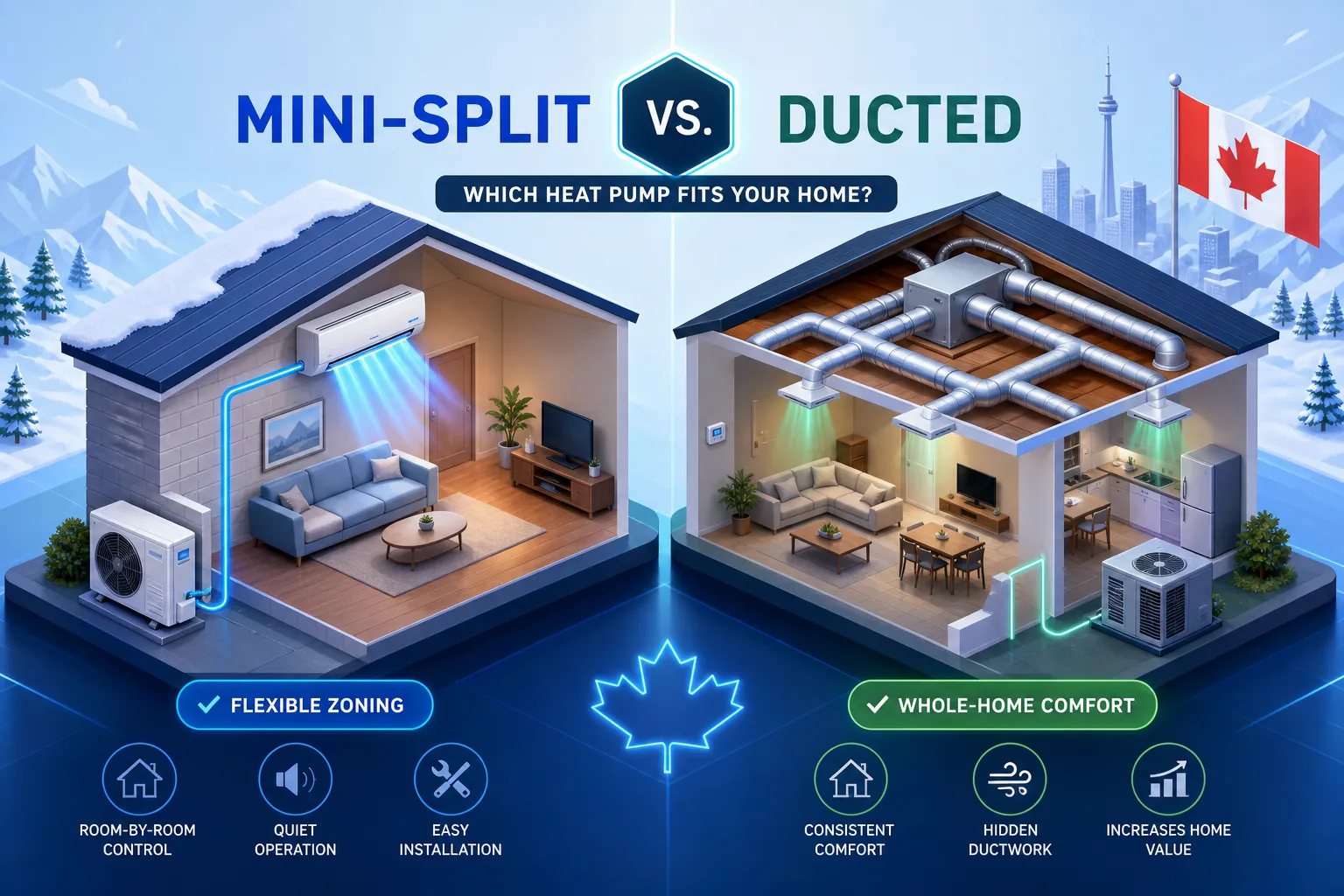
Direct answer: A properly sized multi-zone heat pump can provide reliable winter heating in many Canadian homes, but the architecture is not automatically the best choice for every climate or floor plan. Its shared outdoor unit must have useful capacity at the home's local winter design temperature, a minimum output that suits the smallest active load, a clear defrost and backup-heat strategy, and an approved match with every indoor unit. Several independent single-zone systems or a hybrid ducted and ductless layout may be a better fit when rooms have different schedules, one small room often runs alone, or winter redundancy is a priority.
A multi-zone, also called a multi-split, connects two or more indoor units to one outdoor heat-pump unit. Each indoor unit can usually have its own temperature setting, while the connected rooms share the outdoor compressor, refrigeration circuit, controls, and basic heating or cooling mode. That shared architecture can reduce the number of outdoor cabinets, but it also means that one outdoor-unit decision affects every connected zone.
Canadian winter performance depends on the exact matched combination and the building, not simply on the words “cold climate” or “multi-zone.” Natural Resources Canada's Air-Source Heat Pump Sizing and Selection Guide recommends connecting equipment selection to the building load and local design conditions.
For a broader comparison of shared and independent systems, read Greenfoot's single-zone versus multi-zone heat-pump guide. This article focuses on the winter questions that deserve special attention before a multi-zone system is selected.
What makes a multi-zone heat pump suitable for winter?
Look beyond a unit's lowest operating temperature. An operating limit says that the system can continue to run under a stated condition. It does not show how much heat the system delivers there, how much electricity it uses, or whether that output covers the building load.
Five pieces of equipment data help put a Canadian proposal in context:
- HSPF2 Region V: a seasonal heating-efficiency measure using a colder region for comparison.
- COP at a cold test point: efficiency at one outdoor temperature, rather than a promise about the entire season.
- Heating capacity at -15 C: the published output at a useful cold-climate reference condition.
- Maximum capacity at the local design temperature: the figure to compare with the calculated building load.
- Minimum heating capacity: the low end of the operating range, which affects mild weather and a single small zone.
Natural Resources Canada's current cold-climate screening measures use seasonal efficiency, low-temperature COP, capacity retention, and variable-capacity operation. These are useful screening points, not a substitute for a room-by-room design. Ask for the data for the exact outdoor unit and indoor-unit combination, because a model family name does not describe every approved match.
Why minimum output matters in a multi-zone design
Most proposals emphasize maximum output because winter design days require enough heat. Minimum output can be just as important through the many milder hours when only one room needs heat. A shared compressor has to turn down far enough to serve that active load without repeatedly reaching the setpoint and stopping.
Consider a home with an open main floor and several bedrooms. On a cold morning, the connected rooms may call together and give the outdoor unit a useful combined load. On a mild night, only one closed bedroom may need heat. If that room needs less output than the shared system can stably provide, controls manage the difference, but cycling or temperature overshoot becomes more likely.
Several independent single-zone systems change the relationship. A small bedroom can have its own smaller compressor while the rest of the home remains off. This does not establish that independent systems always use less electricity. A well-matched multi-zone system can use diversity effectively when connected rooms have similar schedules and call together. The correct question is whether the proposed minimum and maximum outputs fit the actual room loads.
Ask the contractor what happens when only the smallest indoor unit calls for heat. The answer should include the outdoor unit's minimum output, controls, sensor location, and expected operating pattern, not only a nominal capacity or efficiency label.
How Canadian regional climates change the review
Coastal British Columbia
Coastal B.C. usually has milder winters than the Interior, but damp weather near freezing can create frequent frost on an outdoor coil. Review minimum output, cycling, defrost behaviour, condensate drainage, salt and wind exposure, and summer moisture control. Protect the outdoor unit from roof runoff and place it where leaves, standing water, or snow sliding from a roof cannot block airflow.
Interior British Columbia
Interior communities can have lower winter design temperatures and greater temperature swings. The proposal should show useful capacity at the local design condition, rather than only a low-temperature operating limit. Snow clearance, a raised stand where appropriate, defrost water, wind exposure, and the location of backup heat deserve explicit planning. BC Hydro's heat-pump retrofit best-practices guide is a useful Canadian reference for installation details.
Atlantic Canada
Atlantic homes may experience long heating seasons, wind, humidity, snow, salt air, and cold snaps. The equipment should be reviewed using the local load and the exact matched performance data. Defrost drainage and coil access are particularly important in damp weather. The NB Power cold-climate multi-zone heat-pump guide provides regionally relevant context, but a New Brunswick example does not replace a calculation for a different Atlantic community.
Defrost, balance point, and backup heat
During heating, an outdoor coil can become cold enough for moisture to freeze on its surface. The heat pump periodically reverses operation or uses its controls to clear that frost. Normal indoor heating output drops during a defrost event. With one multi-zone outdoor unit, every connected indoor unit shares the effect of that outdoor coil event. With several independent systems, each system defrosts separately, so the impact can remain limited to one area.
The thermal balance point is the outdoor temperature at which the heat pump's available output equals the building's calculated load. Below that point, supplemental heat may cover the gap. Backup might be electric resistance heat, an existing furnace or boiler in a dual-fuel arrangement, or another retained heating source. The equipment and controls determine when it starts, including during a cold snap, defrost, sensor fault, or recovery from a setback.
Do not assume that backup heat will be used only in extreme weather. Ask for the intended balance-point setting and how the controls avoid bringing resistance heat on earlier than necessary. A shared outdoor-unit failure can affect every connected room, so include the home's remaining heat source and a service plan in the winter discussion.
Sizing starts with rooms, not head count
A room-by-room heating and cooling load is the foundation of a multi-zone proposal. A recognized Canadian framework such as CSA F280 considers local outdoor design conditions, insulation, windows, orientation, air leakage, ventilation, shading, and room geometry. A whole-home total does not show how that load is divided between a large open area and small closed rooms.
Distribution matters as much as capacity. A wall-mounted head conditions the space reached by its airflow. Closed bedrooms, stairwells, basements, cathedral ceilings, and rooms with different solar exposure may need separate terminals or a compact ducted zone. A home with usable central ducts should also compare a ducted central heat pump, rather than assuming every room needs a wall head.
A hybrid arrangement may be the most sensible answer: one single-zone system for an open main floor, a compact ducted system for bedrooms, and an independent basement zone. Greenfoot's mini-split heat-pump service can be compared with the home's existing ducts, envelope, and comfort goals before equipment is selected.
Cost, maintenance, and failure consequences
One outdoor unit does not guarantee a lower installed price. A multi-zone design can reduce cabinets, pads, disconnect locations, and exterior placements. It can also require longer line routes, more complex drainage, shared controls, additional refrigerant, and exact equipment matching. Independent systems repeat some outdoor and electrical work, but a direct line route may be simpler in a particular home.
Compare complete scopes, including model numbers, indoor terminals, line-set routing, electrical work, permits, condensate drainage, snow stands, wall repairs, pressure testing, evacuation, charge verification, commissioning, warranty, and exclusions. Current rebates also depend on province, utility, fuel, income, equipment, contractor, and program status. Check Greenfoot's provincial incentives guide and confirm the official rules before work begins.
Indoor maintenance follows indoor-unit count. Four heads mean four filters, indoor coils, fans, and condensate paths whether they share one condenser or connect to separate outdoor units. Independent systems add outdoor coils, fans, controls, and cabinets. A shared outdoor fault can affect every connected zone, while an independent-system fault usually affects its assigned area. Neither consequence proves one architecture is more reliable, but it should be part of the household's winter plan. Greenfoot's heat-pump maintenance service provides a reference for ongoing care.
Plan outdoor locations for manufacturer clearances, service access, stable mounting, snow and roof-runoff protection, defrost-water drainage, sound, windows, property lines, and electrical disconnect access. Coastal locations add salt exposure. Interior and mountain locations add snow and freeze-thaw concerns. Future expansion also needs a model-specific review: an unused multi-zone port does not guarantee that a later indoor unit will be compatible.
Questions to ask before choosing a multi-zone system
- What is the calculated heating and cooling load for every room or zone?
- What outdoor design temperature applies to this address?
- What are the exact minimum and maximum outputs of the matched combination?
- What capacity and COP apply at the local winter design temperature?
- What happens when only the smallest indoor unit calls?
- How is capacity divided when all connected rooms call together?
- Do the indoor units share one heating or cooling mode?
- What backup heat remains, and when do the controls bring it on?
- Where will defrost water drain, and how will snow and roof runoff be managed?
- What heat remains if the shared outdoor unit stops?
- What testing, evacuation, charge verification, airflow checks, and commissioning records are included?
- Which current provincial or utility program applies to this exact system?
The winter decision in one sentence
Choose a multi-zone system when the connected rooms, schedules, outdoor space, and exact cold-weather performance make shared equipment a good fit. Give independent single-zone or hybrid systems priority when small loads run alone, rooms need different modes, distribution is difficult, or keeping some heat during a common outdoor-unit fault matters more.
There is no Canadian architecture that always wins. Start with the room loads and local climate, compare minimum and cold-weather capacity, and make backup heat and installation quality part of the design. The best winter system is the one that matches the house through both a cold design day and a mild shoulder-season evening.
Canadian sources
- Natural Resources Canada: Heating and cooling with a heat pump
- Natural Resources Canada: Air-source heat-pump sizing and selection guide
- Better Homes B.C.: Heat-load calculation
- BC Hydro: Heat-pump retrofit best practices for contractors
- Hydro-Quebec: Matching heat-pump capacity to a home
- NB Power: Using and maintaining your heat pump
Technical information and regional program details reviewed September 11, 2026. Equipment ratings, local conditions, and program rules can change. Confirm current requirements with the official program administrator and compare the exact equipment combination in your proposal.