
If your home has usable ducts, start by comparing ducted air-source heat pumps. Without ducts, a ductless mini-split often avoids a major renovation. Homes with hot-water radiators need a different assessment. Geothermal adds another option where the property and budget support a ground loop.
This heat pump types comparison explains distribution, winter performance, installation work and rebate planning for homeowners in Atlantic Canada and British Columbia. Greenfoot installs geothermal systems in New Brunswick only.
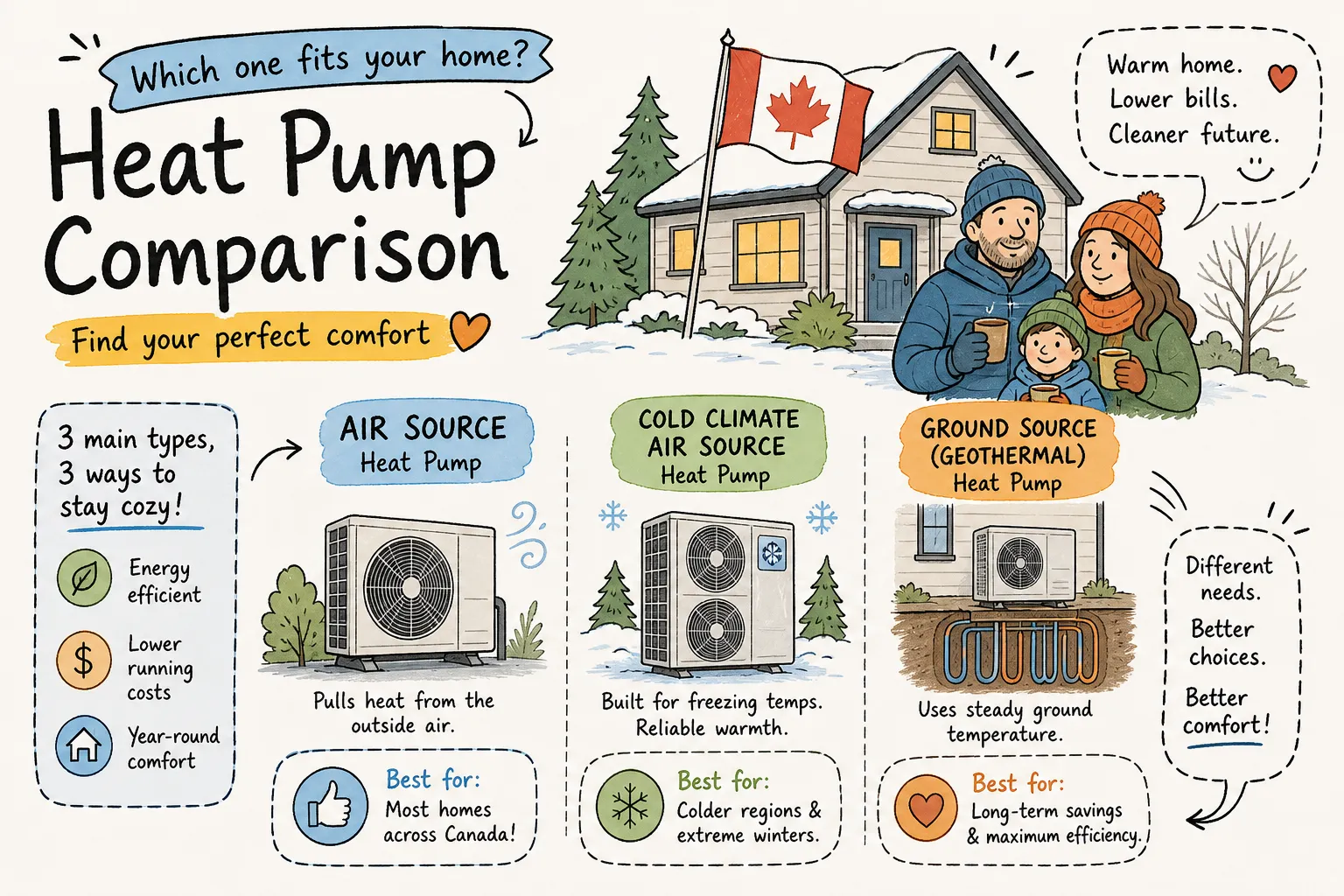
Which heat pump type fits your home?
Start with your existing heating system and the rooms you need to heat. A single indoor head in an open living room does not establish whole-home coverage for closed bedrooms upstairs.
| System | Best starting point | Work to assess | Main limitation |
|---|---|---|---|
| Ducted air-source | A home with suitable forced-air ducts | Duct airflow, indoor air handler, electrical supply and controls | Undersized or leaky ducts need correction |
| Ductless mini-split | A home without ducts, an addition or a specific heating zone | Indoor-unit placement, refrigerant lines, drainage and electrical supply | Closed rooms and separate floors need a distribution plan |
| Ground-source, or geothermal | A suitable property with a long-term ownership plan | Ground-loop design, drilling or excavation, permits and indoor distribution | Higher installation cost and site requirements. Greenfoot installation: New Brunswick only |
| Air-to-water | A home with compatible low-temperature hydronic heating | Required water temperature, radiator output, piping and controls | Existing high-temperature radiators are not automatically compatible |
Cold-climate describes performance, not a separate heat source. Both ducted and ductless air-source systems include cold-climate models. The supplied illustration shows air-source and cold-climate equipment separately, but these categories overlap.
How do ducted and ductless heat pumps work?
Both move heat between outdoor air and your home through a refrigerant circuit. In heating mode, the outdoor coil absorbs heat and the indoor equipment releases heat indoors. In cooling mode, the cycle reverses.
Ducted air-source: heating through a central air handler
A central system distributes conditioned air through supply ducts and draws air back through return ducts. Existing furnace ducts provide a useful starting point, but a contractor still needs to check airflow, leakage, sizing and insulation. Reusing unsuitable ducts compromises comfort and efficiency.
Ask whether your quote includes duct repairs, balancing and backup-heat controls. Read our mini-split versus ducted heat pump guide for a closer look at distribution choices.
Ductless mini-split: heating individual rooms or zones
Refrigerant lines connect an outdoor unit to one or more indoor units. Wall-mounted heads are common. Floor-mounted and ceiling-mounted options depend on the equipment and the building.
A single-zone system pairs one outdoor unit with one indoor unit. A multi-zone arrangement connects several indoor units to a shared outdoor unit. Compare the costs of single-zone and multi-zone systems before deciding how many rooms to serve.
Ductless equipment avoids duct leakage, but placement still matters. A head in a hallway does not guarantee even temperatures behind closed bedroom doors. Ask for the proposed capacity and distribution strategy for each room.
When does geothermal deserve a closer look?
A ground-source heat pump exchanges heat with the ground through a buried fluid loop. Ground temperatures fluctuate less than outdoor air temperatures, which supports steadier operating conditions through winter.
Horizontal loops require excavation and enough usable land. Vertical loops require drilling, suitable access and a design matched to the site. Loop sizing, soil or rock conditions, permitting and landscape restoration affect both the schedule and the price.
Geothermal deserves a project-specific operating-cost comparison. Do not assume the lowest bill or a fixed payback period. Include pumping energy, electricity rates, maintenance and the full installed cost. Greenfoot provides geothermal installation in New Brunswick, not across all five provinces.
What about air-to-water systems and existing radiators?
An air-to-water heat pump takes heat from outdoor air and transfers heat into water for a hydronic distribution system. Radiant floors often operate at lower water temperatures than older radiators. Existing radiators need an output check at the proposed heat-pump water temperature.
A boiler replacement also needs a plan for domestic hot water, backup heating and controls. Space heating and hot tap water are separate design requirements. Read your options for replacing a boiler with a heat pump before assuming the existing piping makes conversion straightforward.
HSPF2 and SEER2 ratings for air-to-air equipment do not establish the performance of an air-to-water system. Compare the relevant hydronic test data, including capacity and COP at the water temperature your home needs. Discuss regional equipment availability with your contractor.
What installation work should your quote include?
A straightforward single-zone installation sometimes takes a day. Multiple zones, difficult access, electrical changes, duct alterations and ground-loop work extend the schedule. Ask for a written scope rather than treating a general timeline as a promise.
- Design: room-by-room heat loss, local winter design temperature and the proposed heating coverage.
- Exact indoor and outdoor models, their matched combination and low-temperature output.
- Electrical load assessment, required circuits and any confirmed service changes. A heat pump does not automatically require a 200-amp panel.
- Outdoor mounting above expected snow accumulation, defrost drainage and access for maintenance.
- Ductwork, refrigerant piping, condensate drainage, permits, commissioning and removal of old equipment where required.
- Backup heating, thermostat settings, warranties and the responsibilities of each contractor.
Our guide to room-by-room heat-load calculations explains why floor area alone is not enough for equipment selection.
Which ratings matter during a Canadian winter?
HSPF2 describes seasonal heating performance for air-to-air equipment under a defined test procedure. SEER2 describes seasonal cooling efficiency. COP compares heat delivered with electricity consumed at a stated operating condition.
For example, a COP of 2 means two units of delivered heat for each unit of electricity under the stated test conditions. This is not a year-round bill-savings guarantee.
The PNNL cold-climate sizing guide lists ENERGY STAR cold-climate benchmarks including a COP of at least 1.75 at −15°C (5°F), and at least 70% of rated heating capacity at −15°C compared with 8.3°C (47°F). Its listed HSPF2 thresholds are 8.5 for ductless and 8.1 for ducted systems. These benchmarks are not a substitute for checking a Canadian rebate program’s eligible-product list.
Ask for the selected system’s output at your local winter design temperature. An advertised operating limit of −25°C does not establish enough heating capacity for your house at −25°C. Defrost, backup heating and the minimum output in milder weather also matter.
Read our multi-zone winter-performance guide if several indoor units will share one outdoor unit.
How should you compare installation and operating costs?
Compare quotes for the same heating coverage. A single-room mini-split price is not a whole-home conversion price. Duct repairs, the number of indoor units, electrical work, oil-equipment removal and ground-loop construction change the total.
Start with the installed price before rebates. Then separate confirmed incentives from conditional funding and financing costs. For an oil-heated home, our oil-to-heat-pump cost guide explains the scope items to include.
Estimate annual energy use using your heating history, current fuel and electricity prices, expected equipment performance and backup-heat use. Natural-gas replacement does not guarantee lower heating bills. Avoid a fixed payback claim without those inputs.
Address insulation and air leakage before final equipment selection when those upgrades form part of your project. Lower heat loss reduces the required heating output, although equipment sizing still needs a calculation. Compare income-qualified insulation support separately from heat-pump funding.
Which rebates should you check before buying?
National Heat Pump Rebate: applications expected in early 2027
As checked on November 9, 2026, the official National Heat Pump Rebate page says the application portal is expected in early 2027. Eligible installations from November 1, 2026 are subject to retroactive approval. Funding is not guaranteed until an application is approved.
The announced amounts are $2,000 for eligible households above the income threshold, or up to $10,000 for qualifying low- to median-income households. Actual funding depends on income, equipment cost and the program rules. No pre- or post-installation energy audit is required under the published federal criteria.
Check the official eligible-product list using the matched equipment’s AHRI number. The system must be appropriately sized to heat the whole home and purchased from and installed by an HVAC contractor. The published rules include Canadian residency and home ownership, an Indigenous-community ownership exception, no previous federal heat-pump funding at the address, and one rebate per household even with multiple properties.
Keep invoices, proof of payment, model and AHRI numbers, the installation address and contractor details. The federal page requires receipts within six months but does not identify the starting point for that period. Confirm the applicable submission timing when the portal opens. Do not assume geothermal or air-to-water equipment qualifies without an eligible listing.
Provincial and utility programs in Greenfoot’s service regions
- New Brunswick: check SaveEnergyNB residential programs for the current Total Home and income-qualified options.
- Nova Scotia: use Efficiency Nova Scotia’s residential resources to check assessments, equipment requirements and program availability.
- Prince Edward Island: review efficiencyPEI programs and rebates before arranging your installation.
- Newfoundland and Labrador: the income-qualified TakeCharge Greener Homes Program is separate from the closed federal Greener Homes Grant. Funding, waitlists and approval requirements apply.
- British Columbia: start with CleanBC Better Homes. Eligibility depends on the program, current heating fuel, income, equipment and contractor requirements.
The original Canada Greener Homes Grant and Loan are closed to new applications. Do not treat old OHPA deadlines as a current offer. Confirm the exact provincial intake and any required pre-approval before work starts. Federal and provincial funding does not automatically stack. Our guide to which Greener Homes programs are still open explains the distinctions.
What should you ask Greenfoot before choosing a system?
Bring your heating bills, a description of problem rooms and your renovation plans. Ask the team to compare distribution, winter capacity, electrical requirements and backup heating for your home. Request an itemized quote and confirm rebate requirements before accepting an installation date.
Greenfoot serves homeowners in New Brunswick, Nova Scotia, Prince Edward Island, Newfoundland and Labrador, and British Columbia. Equipment and service availability vary by region. Geothermal installation is limited to New Brunswick.
Contact Greenfoot to discuss a heat-pump assessment and compare options for your home.
Heat pump comparison FAQs
Is a cold-climate heat pump different from an air-source heat pump?
Cold-climate identifies low-temperature performance within the air-source category. Both ducted and ductless air-source systems include cold-climate models. Compare the matched system’s capacity and efficiency at your local winter design temperature.
Does one ductless indoor unit heat an entire house?
One indoor unit serves a room or zone. Closed doors, separate floors and the building layout limit heat distribution. Whole-home coverage needs a room-by-room heat-loss calculation and a distribution plan, not an assumption based on total floor area.
Does Greenfoot install geothermal in every service province?
No. Greenfoot installs geothermal systems in New Brunswick only. A ground-loop assessment must establish property access, soil or rock conditions, loop design and installation scope.
Are existing hot-water radiators compatible with a heat pump?
Compatibility depends on radiator output at the proposed water temperature and the home’s heat loss. Some projects need larger emitters, insulation improvements or a different distribution approach. Domestic hot water also needs a separate plan.
Is the National Heat Pump Rebate open for applications?
As of November 9, 2026, applications are expected in early 2027. Eligible installations from November 1, 2026 are subject to retroactive approval. Equipment, whole-home sizing, ownership and previous-funding rules apply. Funding is not guaranteed before approval.
Should I subtract federal and provincial rebates from my quote?
Keep the full installed price visible. List confirmed incentives separately from conditional funding. Check each program’s intake, pre-approval, equipment and stacking rules before relying on a combined rebate amount.