
A cold upstairs bedroom, a damp basement and a high heating bill often point to different problems. Buying a larger heating system will not fix all of them. A home energy retrofit starts with the building, then matches insulation, ventilation and equipment to the work your home needs.
This guide focuses on Greenfoot’s service areas in New Brunswick, Nova Scotia, Prince Edward Island, Newfoundland and Labrador, and British Columbia. You will find a practical upgrade sequence, a way to build your budget and funding checks to complete before work starts. Service and equipment availability depend on your location.
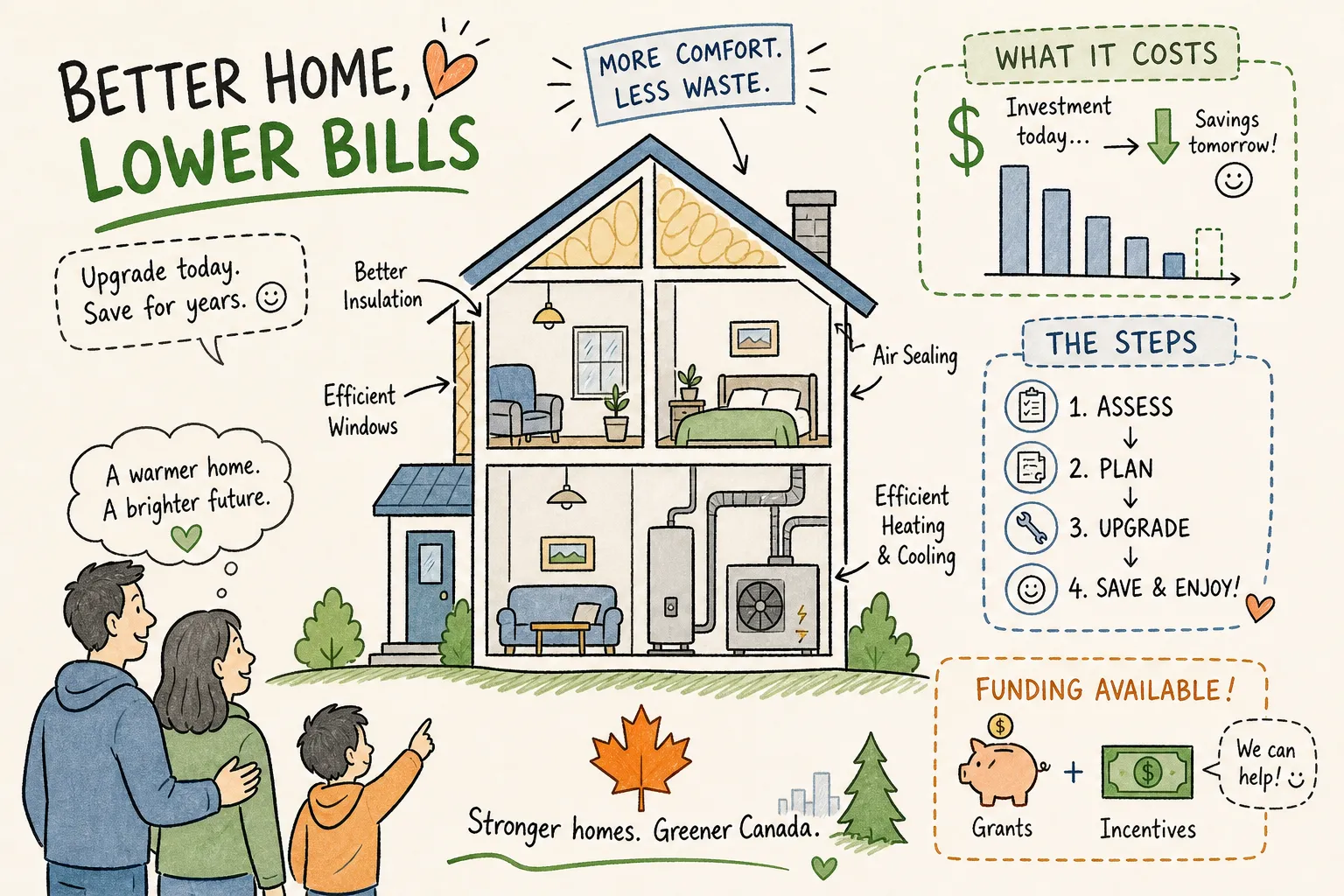
Start with the house, not a product list. Resolve water and safety problems. Check program requirements. Assess air leakage and insulation. Plan ventilation alongside air sealing. Size heating equipment for the improved home, then review water heating and solar.
What belongs in a home energy retrofit?
A retrofit improves an existing home. The scope ranges from sealing an attic hatch to coordinating insulation, a cold-climate heat pump, ventilation and solar. A deep retrofit tackles several sources of energy use together. Your project does not need every available upgrade to produce a worthwhile improvement.
Separate three goals when you plan: correcting building problems, reducing energy use and replacing worn equipment. A leaking roof needs repair even without energy savings. A failed furnace needs a timely heating solution. Neither decision should depend on a rebate arriving first.
Greenfoot’s relevant residential services include insulation, mini-split and ducted heat pumps, ventilation and indoor air quality, water heating and residential solar. Geothermal installation is offered in New Brunswick only. Ask your local team which services and equipment suit your address.
Windows, roofing, drainage, hazardous-material remediation and structural repairs also affect a retrofit. Treat them as separate scopes with the appropriate qualified contractor. Do not assume a whole-home energy plan means Greenfoot supplies every trade.
Put the work in the right order
- Fix water and safety issues. Resolve active leaks, unsafe wiring, combustion concerns and damaged materials before covering an assembly.
- Check funding before starting. Confirm any required assessment, registration, pre-approval and contractor rules.
- Assess the building. Review bills, insulation, air leakage, moisture, room comfort and existing equipment.
- Improve the envelope and review ventilation. Seal suitable leakage paths before adding insulation. Include fresh-air needs and combustion safety.
- Choose equipment for the revised heating load. Coordinate heating, water heating, electrical requirements and any backup system.
- Evaluate solar and verify the finished work. Check roof readiness, utility rules, controls, documentation and a maintenance plan.
For the building-science background behind this sequence, read where to start with home upgrades. The sequence is a planning tool, not a reason to leave a home without reliable heat. An emergency replacement needs a safe immediate solution and a realistic plan for later improvements.
Decide whether an EnerGuide evaluation belongs in your plan
An EnerGuide home energy evaluation by a registered energy advisor provides a label, a Homeowner Information Sheet and a Renovation Upgrade Report. A blower-door test helps measure air leakage. Those findings support a more informed scope, especially when several upgrades are under consideration.
An energy evaluation and an HVAC heat-loss calculation serve different purposes. The advisor reviews the home’s energy performance. The HVAC design determines the heating needed at local winter design conditions, including room-by-room distribution. Ask who supplies each calculation and whether the design reflects the insulation work you intend to complete.
Some funding programs require an evaluation before and after work. Others follow different rules. The announced National Heat Pump Rebate does not require a pre- or post-installation energy audit. Check the specific program instead of treating an evaluation as either universally mandatory or unnecessary. Greenfoot’s project consultation is not automatically an EnerGuide evaluation.
Seal air leaks and insulate suitable areas
Air sealing limits uncontrolled air movement through gaps. Insulation slows heat transfer through the building assembly. They do different jobs, so adding insulation over an open attic penetration leaves part of the problem unresolved.
Start with accessible areas identified during the assessment. An attic hatch, plumbing penetrations and basement rim joists deserve attention when they are leaking. The right work depends on access, moisture conditions, existing insulation and the assembly’s ability to dry. Do not seal required vents or interfere with appliance clearances.


Greenfoot offers blown-in, spray foam and batt-and-poly insulation services. None is the default answer for every surface. Compare the approaches in our spray foam versus blown-in insulation guide. Ask the estimator to identify the area, target insulation level, air-sealing details, preparation and exclusions in writing.
For existing walls, access and cavity condition matter. Opening finished walls solely to add insulation is a different project from treating an accessible attic. Combine wall work with a planned renovation when the construction details and budget support the approach. Check the existing assembly before choosing a material.
Do not cover a moisture problem. Roof leaks, wet sheathing, persistent basement water, mould concerns or suspect hazardous materials need assessment first. An insulation quote should identify any conditions requiring repair or another qualified trade before installation.
Review ventilation as the home gets tighter
Uncontrolled leakage is not a ventilation strategy. After air sealing, review bathroom exhaust, kitchen exhaust, indoor humidity and fresh-air delivery. An HRV or another suitable ventilation system needs sizing, installation and balancing for the home. A heat pump heats and cools rooms but does not replace a dedicated fresh-air system.
Describe the symptoms during your consultation. Window condensation, lingering bathroom moisture and stale bedrooms help focus the review. Avoid treating a ventilation unit as a universal fix for water entering through a foundation or roof.
Match the heat pump to the improved home
A lower heating load changes the equipment discussion. Insulation does not automatically mean a smaller unit, but the revised calculation should determine the choice. An oversized system introduces comfort and cycling problems. An undersized whole-home design puts more demand on backup heat.
Compare heat pump types and their installation needs before choosing a configuration. A mini-split serves a space through an indoor head. A ducted system distributes air through a duct network. Multiple heads, transfer paths and closed bedroom doors affect how heat reaches individual rooms.
Ask for the equipment’s output at your winter design temperature, its minimum output in milder weather and the backup strategy. Rated capacity alone does not explain cold-weather performance. Our room-by-room heat pump sizing guide explains the information a useful design should contain.
Existing ducts need checks for airflow, leakage, sizing and return-air paths. Electrical capacity, outdoor-unit placement, condensate disposal, snow clearance and service access also affect the installed scope. Keep oil-tank removal or other decommissioning costs separate where those services are required.
If you are replacing oil heat, use our oil-to-heat-pump cost guide to review the work beyond the equipment. Compare projected running costs using your own fuel bills, electricity rates and expected backup use. Do not budget around a universal percentage saving.
Review water heating without treating every tank as interchangeable
A heat pump water heater draws heat from the surrounding air. The installation needs suitable room volume, airflow, drainage, electrical service and access. Noise and the cooling effect on the room matter too, particularly near bedrooms or in a small utility space.
Discuss household demand, recovery time and the installation location when comparing water-heating options. In a heated basement, part of the heat collected by the water heater comes from your space-heating system during winter. Include that interaction in the operating-cost discussion.
Ask for a written equipment and installation scope. Do not assume a free tank, a bundle discount or rebate eligibility without current terms for the specific offer and your address.
What a retrofit costs, and how to build a useful budget
There is no single Canadian whole-home retrofit price. An attic top-up and one mini-split are not comparable to major envelope work, a ducted system and solar. Greenfoot needs the property details before quoting a project. A national price range without a defined scope is a weak basis for a financing decision.
Build the budget from itemized quotes. Record the installed price before rebates, taxes, any separate-trade work and what each contractor excludes. Then list confirmed funding separately from amounts awaiting approval.
| Work item | What changes the price | What to request in the quote |
|---|---|---|
| Air sealing and insulation | Area, access, existing materials, moisture repairs, target insulation level and disposal | Measured scope, preparation, air-sealing details, material and cleanup |
| Heat pump | Design load, indoor units, ducts, electrical work, placement and backup requirements | Model numbers, winter output, included installation and commissioning |
| Ventilation | Fresh-air needs, duct routes, controls and existing exhaust systems | Equipment selection, installation, balancing and control setup |
| Water heating | Tank size, room suitability, drainage, electrical changes and removal | Equipment, connections, disposal and operating instructions |
| Solar | System size, roof condition, shading, electrical work and utility connection | Production estimate, assumptions, connection scope and warranties |
| Other trades and assessments | Repairs, electrical capacity, hazardous materials and program requirements | Separate estimates and clear responsibility for each task |
A budget example, not a Greenfoot price quote
Suppose your written quotes total $14,000 before tax. A 10% planning contingency adds $1,400, bringing the working budget to $15,400 before tax and borrowing costs. If an approved rebate later pays $2,000, the remaining project cost is $13,400 on those assumptions.
These figures illustrate the arithmetic only. They are not typical installed prices, a recommended contingency or a promise of funding. Until approval and payment timing are confirmed, plan for the full amount due under your contracts.
Compare the same scope across quotes. A lower equipment price loses its advantage if another quote includes electrical work, duct changes, permits and commissioning. Ask about warranty terms, labour coverage and future service costs before accepting.
For phased work, write down what the first phase leaves for later. Paying twice to open an area or redo electrical work sometimes costs more than coordinating compatible tasks. Other projects are easier to fund in stages. The building condition, heating urgency and cash flow should drive the schedule.
Check funding without counting the same dollars twice
The information below reflects program pages checked on November 9, 2026. Our 2026 Greener Homes program guide separates the closed original Grant and Loan from newer programs. Their names are similar, but their application routes and eligibility differ.
National Heat Pump Rebate: applications expected in early 2027
The federal government has announced $2,000 for eligible above-median-income households and up to $10,000 for eligible low- to median-income households. The official National Heat Pump Rebate page says the application portal is expected in early 2027. Funding is not guaranteed until an application is approved.
Eligible installations from November 1, 2026 enter a conditional retroactivity period. The published criteria include eligible equipment identified by AHRI number, contractor installation and a system appropriately sized to heat the whole home. The address must not have received previous federal heat-pump funding. Only one rebate is available per household.
No pre- or post-installation energy audit is required for this federal rebate. Other programs still have their own assessment requirements. Keep detailed invoices and check submission timing on the official page. Do not treat a single-room installation or an advertised model name as proof of eligibility. Our National Heat Pump Rebate guide explains the current criteria.
Income-qualified retrofit programs use provincial delivery partners
The Canada Greener Homes Affordability Program supports qualifying homeowners and tenants through participating provincial and territorial programs. Selected organizations arrange approved work through a direct-install approach. This is not a general reimbursement for any privately arranged renovation.
For insulation-specific routes, read when home insulation qualifies for no-cost programs. Confirm eligibility and the authorized delivery process before paying for work you expect a program to cover.
- New Brunswick: Check SaveEnergyNB residential programs for the applicable assessment, income and upgrade pathway.
- Nova Scotia: Review Efficiency Nova Scotia. The Home Energy Assessment route and income-qualified programs have different rules.
- Prince Edward Island: Start with efficiencyPEI and confirm the process for your proposed insulation or heating work.
- Newfoundland and Labrador: Review takeCHARGE’s Greener Homes program for qualifying households. Do not confuse this provincial delivery route with the closed original federal Grant.
- British Columbia: Check Better Homes BC alongside your utility’s rules. Income, existing heating fuel, equipment and registration affect the available pathway.
Combining incentives requires checking each program’s rules. Do not add every advertised maximum together or assume two programs pay for the same expense. Ask the administrators which funding sources must be disclosed and whether total assistance is capped at eligible costs.
Plan solar around the home’s future electricity use
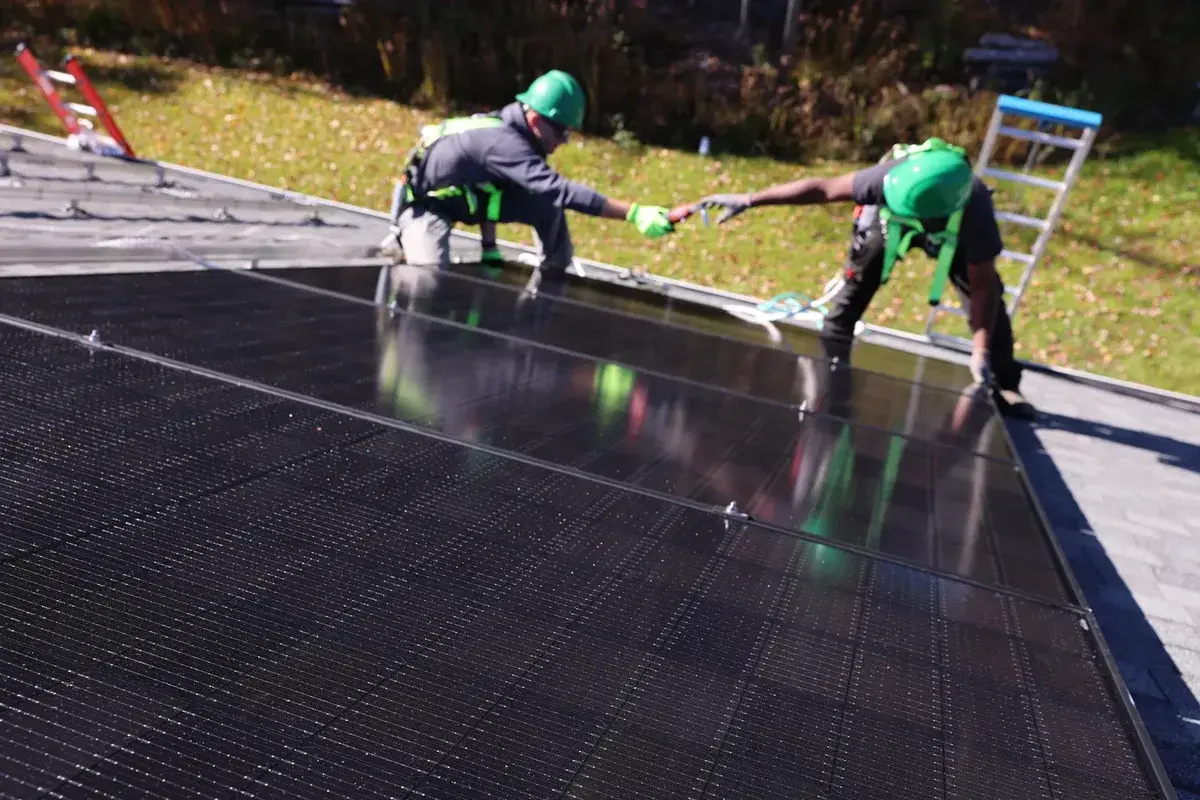
Reducing heat loss lowers demand. Electrifying space and water heating changes the electricity profile. Those changes belong in the residential solar estimate rather than sizing a system around an old bill alone.
Ask for an annual production estimate with stated shading and roof assumptions, then compare the estimate with expected consumption and your utility’s export-credit rules. Solar does not eliminate the need for winter heating design. A standard grid-connected system also does not provide backup power during an outage without suitable additional equipment.
Check the roof’s condition before installing panels. Re-roofing shortly afterward introduces removal and reinstallation work. Greenfoot’s residential solar project milestone provides context on our work, but your production and economics still need a property-specific assessment.
Finance the remaining cost on terms you understand
The original Canada Greener Homes Loan is closed to new applications. Compare current lender or local financing options using the amount borrowed, interest rate, fees, payment schedule and total cost over the full term. A lower monthly payment often means a longer repayment period.
Review Greenfoot’s financing information and request the current terms for your project. Approval and product eligibility apply. A temporary heat-pump promotion is not a sitewide promise of interest-free solar or insulation financing. Budget for rebate payment delays separately from the contractor’s payment dates.
Bring this checklist to your consultation
- Twelve months of fuel and electricity bills, your address and the rooms causing comfort problems.
- Equipment ages, maintenance history, visible moisture concerns and any planned roof or interior renovations.
- Program correspondence, approval dates and any assessment reports.
- A written scope for each upgrade, including electrical work, permits, disposal and exclusions.
- A named contact for scheduling and clear responsibility for other trades.
- Commissioning results, equipment model and AHRI numbers where relevant, invoices, warranties and operating instructions after installation.
Do not submit sensitive tax information to a contractor to establish federal rebate income eligibility. Follow the program administrator’s secure application process. Keep the project records together so equipment selection, approval and final invoices refer to the same work.
Plan the work your home needs
Tell Greenfoot where you live, what heats your home and which comfort or energy problems you want to address. We will review the relevant local services and help you understand the proposed work and application steps. Program administrators decide funding eligibility.
Home energy retrofit FAQs
Should insulation come before a heat pump?
Plan both together. Complete suitable envelope improvements before final equipment sizing when the schedule allows. If your heating system fails, prioritize safe heat and ask the designer to account for planned insulation work rather than delaying an urgent replacement.
Does Greenfoot install replacement windows?
Window replacement is not a service offered in this guide. Greenfoot’s relevant work includes insulation, heat pumps, ventilation, water heating and solar, subject to local availability. Discuss window condition with an appropriate window contractor and coordinate any related envelope details.
Is an EnerGuide evaluation required for every rebate?
No. Requirements depend on the program. The announced National Heat Pump Rebate does not require pre- or post-installation energy audits. Provincial programs and other funding routes have their own assessment and pre-approval rules. Check those rules before work begins.
How long does a whole-home retrofit take?
The schedule depends on approvals, material availability, repair work, the number of upgrades and utility requirements. Request dates for each phase and identify dependencies before signing. An individual installation visit is not the same as the full assessment-to-completion timeline.
Are retrofit rebates guaranteed after installation?
No. Equipment, household, timing and application requirements still apply. The announced National Heat Pump Rebate includes conditional retroactivity for eligible installations from November 1, 2026, but funding requires an approved application after the portal opens. Keep detailed project records and budget for the full contract amount.
Does Greenfoot offer geothermal across all five provinces?
No. Greenfoot offers geothermal installation in New Brunswick only. Ask the local team about air-source heat pumps and other available retrofit services in Nova Scotia, Prince Edward Island, Newfoundland and Labrador, and British Columbia.