
Why should you get an annual heat pump maintenance plan in Canada? Because most Canadian homeowners install a heat pump and then largely forget about it. Not because they're careless, but because the system just quietly runs. It heats in winter, cools in summer, and the bill keeps coming. Then one January morning, it doesn't heat anymore.
Across our work at Greenfoot Energy Solutions, covering 75,000+ installations in Nova Scotia, New Brunswick, PEI, Newfoundland, and British Columbia, the pattern is consistent: the systems that hold up longest are the ones that get a professional set of eyes on them every year. The ones that fail early, or fail expensively, are almost always the ones that didn't.
This article is not a scare piece. It's a plain-language breakdown of what an annual heat pump maintenance plan in Canada actually does, what it costs, and whether the math works in your favor.
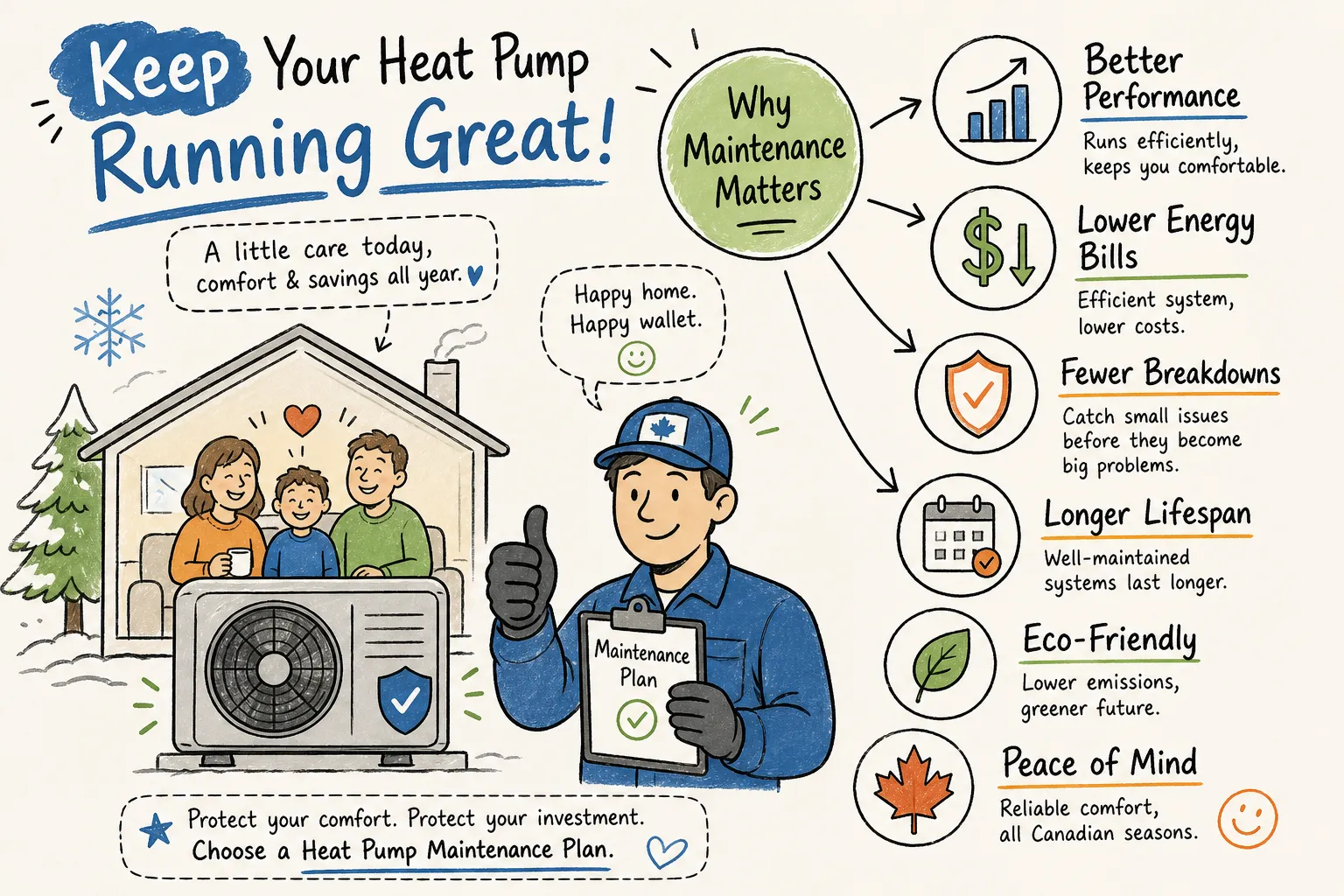
Why Should I Get an Annual Heat Pump Maintenance Plan in Canada?
Here are seven concrete reasons, from warranty protection to lifespan extension, that answer that question with numbers attached.
1. Your warranty may already require it
Skipping annual maintenance doesn't just risk your system. It can legally void the warranty you paid for. This catches most homeowners off guard because warranty terms are buried in registration documents most people never read closely.
What manufacturers actually say about annual service
Daikin's 6-Year Unit Replacement Limited Warranty explicitly requires annual maintenance by a licensed contractor, with written records kept on file. Without that documentation, the enhanced replacement coverage is simply gone. Mitsubishi Electric's extended coverage language in Canada similarly requires maintenance invoices to be kept on file, and in many cases, warranty registration must happen within 30 days of installation. This isn't fine print designed to trap you. It reflects the straightforward reality that a well-serviced unit fails less often and lasts longer — better for the homeowner, better for the manufacturer.
How an annual heat pump maintenance plan in Canada protects your warranty
A successful warranty claim requires proof of purchase, proof of installation by a qualified contractor, registration within the required window (often 30 to 90 days depending on brand), and dated service records from a licensed technician. The gap that most homeowners hit is the service records. One missed year with no documentation and the manufacturer has grounds to deny the claim. The fix is simple: get on a heat pump protection plan, request a written service report at every visit, and keep that paperwork somewhere you can find it.
2. An unmaintained heat pump quietly costs more to run
Heat pumps don't break down dramatically when they're neglected. They just get a little less efficient month after month, and you pay for it on your power bill without ever connecting the two. By the time the inefficiency is obvious, you've already lost a few hundred dollars.
The 10–25% efficiency loss most homeowners miss
The mechanics are straightforward. Dirty coils make the system work harder to transfer heat. Restricted airflow from clogged filters forces longer run cycles. Minor refrigerant issues reduce heat transfer efficiency across the full heating season. According to Natural Resources Canada, an unmaintained heat pump can use 10 to 25% more electricity than a properly serviced one. For a home drawing 8,000 kWh per year through the heat pump, that's 800 to 2,000 kWh wasted annually — without a single breakdown event to signal the problem.
What that actually looks like on a Canadian power bill
At roughly $0.17/kWh, a common blended rate across Atlantic Canada, wasting 1,500 kWh costs about $255 per year. That alone covers the cost of a basic maintenance plan with money left over. The efficiency loss also compounds: a system that runs inefficiently for three to four years doesn't bounce back on its own. A professional annual heat pump tune-up is what resets the baseline, cleans the coils, restores proper airflow, and gets the system back to the efficiency it was designed to deliver.
3. Canadian winters turn small issues into expensive emergencies
A minor fault caught in September is a $200 fix. The same fault discovered when your system stops heating on a -15°C January night in Nova Scotia, or during a wet BC deep freeze, is a very different situation in cost, urgency, and technician availability. The problem isn't just the repair. It's the timing.
The failure types that show up most in Atlantic and BC climates
The most common heat pump failures in Canadian conditions include:
- Ice buildup from defrost-sensor or fan failure
- Refrigerant issues that become acute during cold snaps
- Coils clogged with fall debris before winter sets in
- Electrical or capacitor failures that worsen under sustained heavy load
In Atlantic Canada especially, where damp near-freezing temperatures accelerate frosting and systems run long hours through the season, these aren't edge-case failures. Across our service calls in Atlantic Canada and BC, the vast majority of repair visits trace back to issues a fall inspection would have caught.
Why fall inspections deliver the highest return
Timing a yearly tune-up for late September or October is the most strategically sound move. A technician who catches a borderline defrost control or a low refrigerant charge before the cold settles in can save the homeowner real money and real pain: no emergency callout fee (often $150 to $300 before labor and parts), no extended discomfort during the worst weeks of the year, and no risk of compressor damage from running a compromised system under full load.
Preventative heat pump service before peak season is the highest-ROI version of the plan. It's not about being cautious. It's about not paying emergency rates for a problem that was visible months earlier.
4. Regular service adds years to your system's lifespan
A heat pump that costs $8,000 to $14,000 installed deserves a $200/year maintenance plan the same way a car that costs $40,000 deserves regular oil changes. The alternative isn't just more repairs. It's paying for an early replacement.
The lifespan gap between serviced and neglected systems
Industry averages are clear on this. A heat pump without regular maintenance typically lasts 10 to 15 years. One that gets annual professional service routinely reaches 15 to 20 years. That's roughly a five-year gap. At a replacement cost of $7,000 to $10,000 fully installed in Atlantic Canada, and $8,000 to $14,000 in BC depending on system type, pushing a replacement from year 12 to year 17 is a substantial financial outcome. Annual heat pump maintenance plans in Canada rarely exceed $300/year. Over five years that's $1,500. Against a $10,000 replacement, the math is not close.
What shortens a system's life the fastest
The damage from deferred maintenance is slow and compounding. Restricted airflow strains the compressor over time. Unbalanced fan components cause bearing wear. Corrosion left unaddressed on coils spreads season after season. These aren't instant failures, which is why homeowners miss them until the bill is large.
A yearly heat pump inspection catches these issues at the cheap end of the repair curve. In our service experience, catching a failing capacitor at $80 versus replacing a compressor at $2,500 is one of the most common conversations we have with homeowners who deferred maintenance.
5. What heat pump service plans actually cost and cover in Canada
The concept of a maintenance plan sounds straightforward, but most homeowners don't know what they're actually buying or what a fair price looks like. That gap causes people to either overpay for coverage they don't need, or pick a plan that doesn't deliver much protection at all.
Basic vs. comprehensive plans: what the tiers actually include
Basic maintenance-only plans cluster around $100 to $250/year and typically include one annual tune-up, filter and coil cleaning, electrical safety checks, and a system calibration. In Atlantic Canada, monthly pricing for entry-level plans runs around $12.99 to $16.99 per unit, roughly $156 to $204 per year. Comprehensive protection plans run $300 to $650/year and add a second visit, discounted or covered parts, labor coverage up to certain limits, and priority scheduling during peak periods. The right tier depends largely on the system's age: newer systems under five years do well on basic plans, while older systems benefit from the broader coverage and faster access to parts when something does fail.
How Greenfoot's Yeti Membership is structured for Canadian conditions
Greenfoot's Yeti Membership is a useful benchmark for what a well-structured HVAC maintenance plan in Canada looks like in practice. The plan tiers start at $14/month (Base), $25/month (Summit), and $45/month (Peak), with all tiers delivered by Red Seal certified technicians. That's a meaningful distinction from general contractors or handymen who may not carry the certifications that manufacturer warranty documentation requires. The Yeti Membership covers homeowners across Nova Scotia, New Brunswick, PEI, Newfoundland, and BC, with priority scheduling built in — which matters most when a January breakdown puts every homeowner in the queue at once.
6. Questions to ask before choosing a maintenance plan
Not every maintenance plan is worth signing. A cheap checkbox plan might generate a one-page visit summary that satisfies no manufacturer's documentation requirement and provides no priority access when you actually need a technician. A few direct questions will separate a solid heat pump service agreement from something that mostly benefits the provider.
What to ask any provider before signing up
Run through these before committing to any plan:
- Are your technicians Red Seal certified or licensed HVAC professionals?
- Does the plan include both indoor and outdoor unit cleaning?
- What does the tune-up actually cover, and will you provide a written service report with each visit?
- Is priority service included, or am I still waiting in the general queue during a January breakdown?
- Does this plan satisfy my heat pump manufacturer's warranty documentation requirements?
- What is the claims process if a covered repair is needed?
The one thing most people forget to check
Ask specifically whether the service report the provider generates will satisfy your manufacturer's heat pump warranty maintenance requirements. A plan that doesn't produce a dated, signed service record from a licensed technician is not protecting your warranty, regardless of what the provider claims.
The paperwork is the proof. No documentation means no warranty protection when the claim matters most — and that's precisely the scenario the plan was supposed to prevent.
7. Peace of mind for all Canadian seasons
There's a practical, unsexy benefit that doesn't show up on a spreadsheet: you stop thinking about it. Your system gets looked at before winter, the paperwork is in order, and if something goes wrong you have a member line to call rather than hunting for a technician at peak season. For most homeowners, that alone is worth the monthly cost of a Base plan.
The bottom line on annual heat pump maintenance in Canada
If you've been asking yourself why you should get an annual heat pump maintenance plan in Canada, the answer comes down to money and timing. In Canada's climate, whether you're heating through an Atlantic Maritime winter or a wet BC season, a heat pump that isn't serviced regularly is going to cost you. Efficiency losses, voided warranties, and a shortened system lifespan all show up quietly on your bills, then loudly as a repair or replacement call you weren't planning for.
The math on a $150 to $300/year plan versus even one avoided emergency callout, or a five-year lifespan extension on a $10,000 system, is not a difficult calculation. Use the checklist above. Ask the right questions. Don't accept a plan that can't hand you a dated service report at the end of every visit.
If you're in one of the five provinces where Greenfoot Energy Solutions operates, the Yeti Membership is worth a look as a starting point. Red Seal certified technicians handle the full inspection across all plan tiers, your system gets the attention it needs before peak season hits, and your warranty documentation stays clean.
Frequently asked questions about annual heat pump maintenance plans in Canada
Why should I get an annual heat pump maintenance plan in Canada instead of just calling when something breaks?
Reactive service almost always costs more. Emergency callout fees run $150 to $300 before labor and parts, technician availability during peak winter demand is limited, and by the time a failure is obvious, secondary damage is often already done. An annual plan keeps the system inspected before problems develop, not after.
How much does an annual heat pump maintenance plan cost in Canada?
Basic plans typically run $100 to $250/year (or $12 to $17/month). Comprehensive plans with labor coverage and priority scheduling run $300 to $650/year. The right tier depends on your system's age and how much risk you're comfortable carrying on parts and labor.
Does skipping maintenance actually void my heat pump warranty?
For many manufacturers, yes. Daikin's 6-Year Unit Replacement Limited Warranty requires documented annual service by a licensed contractor. Mitsubishi Electric's extended coverage in Canada has similar requirements. If you can't produce dated service records from a licensed technician, the manufacturer has grounds to deny your claim.
When is the best time to schedule a heat pump inspection in Canada?
Late September or October is the optimal window. That timing catches any issues — defrost sensor wear, refrigerant charge problems, coil debris — before the system is under sustained winter load. Fall inspections consistently deliver the highest return on the cost of the plan.